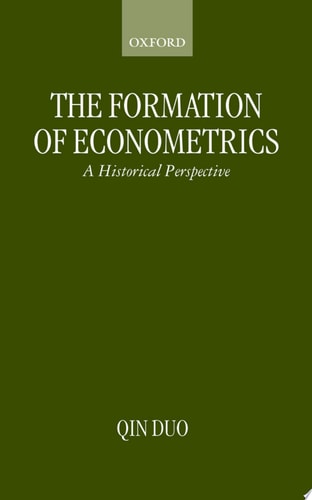
The Formation of Econometrics: A Historical Perspective
0
0
As an Amazon Associate and affiliate partner, Menrva Books earns from qualifying purchases. Learn more
Author Description
Duo Qin has provided a scholarly study of a crucial period in the history of econometrics. She traces the formation of econometric theory during the period 1930-1960, and focuses on the formalization of mathematical and scientific processes to analyse economic problems. This book deals with the advances made in the practice of econometrics as a discipline, in terms of the basic issues is econometric modelling: the probability of foundations, estimations, identification, testing, and model construction and specification. Duo Qin argues that, while the probability revolution in econometrics in the early 1940s laid the basis for the systematization of econometric theory, it was actually an incomplete revolution, and its incompleteness underlay various problems and failures that occurred in applying the newly eastablished theory to modelling practice. Model construction and hypothesis testing remained problematic because the basic problem of induction in econometrics was not properly formalized and solved. The book thus links early econometric history with many issues of interest to contemporary developments in econometrics.
Menrva's Summary
THE THESIS
This book investigates the historical development of econometric theory between 1930 and 1960 to determine why the field's early formalization efforts resulted in persistent practical failures. Duo Qin, an expert in the history of economic thought, utilizes a rigorous analysis of mid-century mathematical and scientific processes to argue that the 'probability revolution' of the 1940s was fundamentally incomplete. By examining the evolution of modeling practices, the author demonstrates how the failure to properly formalize the problem of induction created long-standing obstacles in hypothesis testing and model specification that continue to influence contemporary economic research.
THE SCOPE MAP
What You Will Find
- A detailed historical examination of econometric theory formation from 1930 to 1960.
- Analysis of core methodological issues including probability foundations, estimation, identification, and model construction.
- A critical evaluation of the 'probability revolution' and its limitations in practical application.
- A conceptual framework linking historical failures in induction to modern econometric challenges.
THE AUTHORITY PERSPECTIVE
Experts recognize this work as a significant contribution to the history of economic methodology, noting its ability to bridge the gap between historical theory and modern practice. Readers frequently highlight the academic density of the prose, which is intended for researchers and students familiar with advanced econometric concepts.
Page Count:
228
Publication Date:
1997-07-31
Publisher:
Oxford University Press(UK)
ISBN-10:
0198292872
ISBN-13:
9780198292876
Economics
Econometrics
Mathematics
Academic
Community Tags
Similar Books