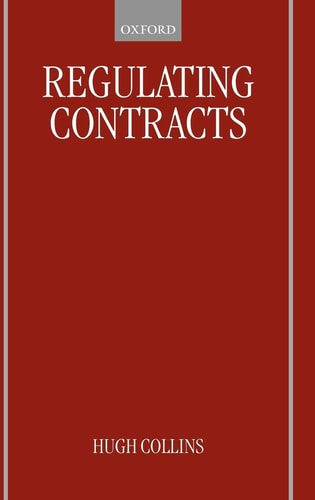
Regulating Contracts
0
0
As an Amazon Associate and affiliate partner, Menrva Books earns from qualifying purchases. Learn more
Author Description
Using an interdisciplinary approach involving economics, sociology, and law, this book examines the purposes, efficiency, and efficacy of legal regulation of contracts and suggests how legal regulation fails and how it might be improved. The conclusions suggest that the law plays an insignificant role in the construction of markets, and that it could provide better assistance by using indeterminate regulation that permits the recontextualization of legal reasoning.
Menrva's Summary
THE THESIS
This book investigates the efficacy and functional purpose of legal regulation within the framework of contract law. Author Hugh E. L. Collins utilizes an interdisciplinary methodology, synthesizing insights from economics, sociology, and jurisprudence to evaluate how legal systems influence market dynamics. The central argument posits that the law exerts a surprisingly limited influence on market construction and advocates for a shift toward indeterminate regulation to enhance legal reasoning.
THE SCOPE MAP
What You Will Find
- An interdisciplinary analysis combining economic theory, sociological perspectives, and legal doctrine.
- An evaluation of the efficiency and practical outcomes of current contract regulation models.
- A critique of traditional legal reasoning and its limitations in modern market environments.
- Proposed frameworks for implementing indeterminate regulation to improve legal assistance in commercial contexts.
THE AUTHORITY PERSPECTIVE
Legal scholars and practitioners frequently cite this work for its rigorous interdisciplinary approach to contract theory. Readers often note the academic density of the prose, which serves as a foundational text for those examining the intersection of law and social science.
Page Count:
408
Publication Date:
1999-10-28
Publisher:
Oxford University Press
ISBN-10:
019829817X
ISBN-13:
9780198298175
Economics
Contract law
Law
Legal Theory
Contracts
Sociology
Community Tags
Similar Books