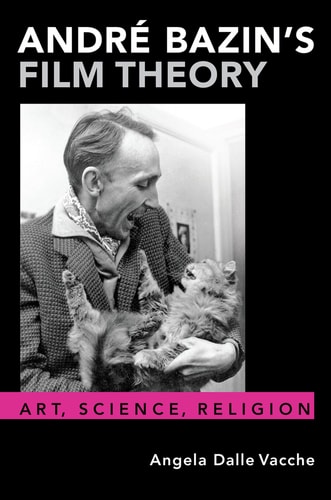
André Bazin's Film Theory: Art, Science, Religion
0
0
As an Amazon Associate and affiliate partner, Menrva Books earns from qualifying purchases. Learn more
Author Description
Through metaphors and allusions to art, science, and religion, André Bazin's writings on the cinema explore a simple yet profound question: what is a human? For the famous French film critic, a human is simultaneously a rational animal and an irrational being. Bazin's idea of the cinema is a mind-machine where the ethical implications have priority over aesthetic issues. And in its ability to function as an art form for the masses, cinema is the only medium that can address an audience at the individual and community levels simultaneously-- the audience sees the same film, but each individual relates to the narrative in a different way. In principle, cinema can unsettle our routines in productive ways and expand our sense of belonging to a much larger picture.By arguing that this dissident Catholic's worldview is anti-anthropocentric, Angela Dalle Vacche concludes that André Bazin's idea of the cinema recapitulates the histories of biological evolution and modern technology inside our consciousness. Through the projection of recorded traces of the world onto a brain-like screen, the cinema can open viewers up to self-interrogation and empathy towards Otherness. Bazin was neither a spiritualist nor an animist or a pantheist, yet his film theory leads also to ideas of a more cosmological persuasion: through editing and camera movement, cinema explores our belonging to a vast universe that extends from the microbes of the microscope to the stars of the telescope. Such ideas of connectedness, coupled with Bazin's well-known emphasis of realism, form the foundation for his film theory's embrace of Italian neorealism. Choosing to avoid a quantitative naturalism based on accumulation of details, Bazin's theory instead promotes the kind of cinema that celebrates perceptual displacement, the objectification of human behavior, and one's own critical self-awareness.
Menrva's Summary
THE THESIS
How does André Bazin’s film theory reconcile the tension between human rationality and irrationality through the lens of art, science, and religion? Angela Dalle Vacche, a scholar of film and visual culture, examines Bazin’s writings to argue that his work is fundamentally anti-anthropocentric. She posits that Bazin viewed cinema as a unique medium capable of mirroring biological evolution and technological advancement, ultimately serving as a tool for self-interrogation and empathy.
THE SCOPE MAP
What You Will Find
- Analysis of Bazin’s philosophical intersections with Catholic thought and modern science.
- Examination of Italian neorealism as a manifestation of Bazin’s realism.
- Exploration of the cinema as a 'mind-machine' that bridges individual experience and community connection.
Scope Limits
- The text does not provide a comprehensive biography of Bazin’s life outside of his theoretical contributions.
- It does not offer a technical manual for film production or editing practices.
THE AUTHORITY PERSPECTIVE
Scholars and film theorists frequently cite this work as a rigorous re-evaluation of Bazin’s intellectual legacy, noting its dense engagement with philosophical and theological concepts. It is widely regarded as a significant contribution to the study of film aesthetics and the history of critical theory.
Page Count:
240
Publication Date:
2020-01-03
Publisher:
Oxford University Press
ISBN-10:
0190067306
ISBN-13:
9780190067304
Philosophy
Humor & Entertainment
Film Theory
Movies
Cinema Studies
New Used & Rental Textbooks
Criticism history
Film & Video
Video photography
Art History
Community Tags
Similar Books