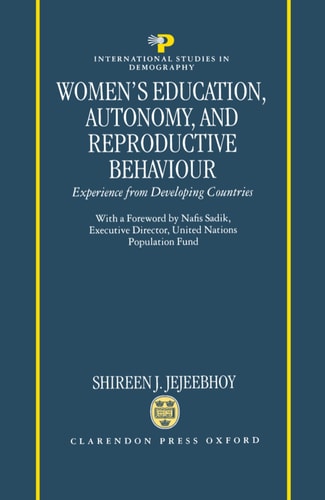
Women's Education, Autonomy and Reproductive Behaviour: Experience from Developing Countries
0
0
As an Amazon Associate and affiliate partner, Menrva Books earns from qualifying purchases. Learn more
Author Description
Women's access to education has been recognized as a fundamental right. At the national level, educating women results in improved productivity, income, and economic development, as well as a better quality of life, notably a healthier and better nourished population. It is important for all kinds of demographic behavior, affecting mortality, health, fertility, and contraception, The personal benefits that women attach to education vary widely according to region, culture, and level of development, but it is clear that education empowers women, providing them with increased autonomy and resulting in almost every context in fewer children. Beyond these few general assertions, however, there is little consensus on such issues as how much education is required before changes in autonomy or reproductive behavior occur; whether the education-autonomy relationship exists in all cultural contexts, at all times, and at all levels of development; and which aspects of autonomy are important in the relationship between education and fertility.It is in the need to address these fundamental issues that this book took shape. The author reviews the considerable evidence about education and fertility in the developing world that has emerged over the last twenty years, and then passes beyond the limits of previous studies to address three major questions:BL Does increased education always lead to a decrease in the number of children, or is there a threshold level of education that a woman must achieve before this inverse relationship becomes apparent?BL What are the critical pathways influencing the relationship of women's education to fertility? Is fertility affected because education leads to changes in the duration of breast-feeding? Because it raises the age at marriage? Because it increases the practice of contraception? Or because education reduces women's preferences for large numbers of children?BL Do improvements in education empower women in other areas of life, such as th
Menrva's Summary
THE THESIS
This book investigates the complex causal relationship between female education, personal autonomy, and reproductive outcomes within the diverse cultural contexts of developing nations. Shireen J. Jejeebhoy, a respected demographer, synthesizes two decades of empirical research to challenge simplistic assumptions about the link between schooling and fertility. She argues that the impact of education is not uniform, but rather mediated by specific cultural, economic, and social thresholds that dictate how women exercise agency over their reproductive lives.
THE SCOPE MAP
What You Will Find
- Comparative analysis of demographic data across various developing regions and cultural settings.
- Examination of the 'threshold effect' regarding years of schooling and fertility decline.
- Investigation into intermediate variables such as age at marriage, breastfeeding duration, and contraceptive usage.
- Evaluation of how education influences women's decision-making power within the domestic and public spheres.
THE AUTHORITY PERSPECTIVE
Experts in the field of demography recognize this work as a rigorous, data-driven examination of the nuances inherent in global development studies. Researchers frequently cite the text for its methodical approach to untangling the multifaceted pathways through which education impacts reproductive behavior.
Page Count:
328
Publication Date:
1996-02-01
Publisher:
Clarendon Press
ISBN-10:
0198290330
ISBN-13:
9780198290339
Reproductive health
Women education
Education
Demography
Sociology
Women
Community Tags
Similar Books