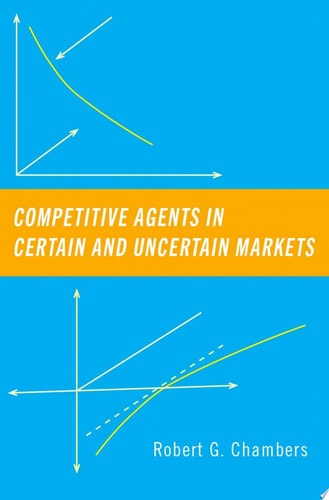
Competitive Agents in Certain and Uncertain Markets
0
0
As an Amazon Associate and affiliate partner, Menrva Books earns from qualifying purchases. Learn more
Author Description
For all its elaborate theories and models, economics always reduces to comparisons. Should we build A rather than B? Will I be better off if I eat D rather than C? How much will it cost me to produce F instead of E? At root, the ultimate goal of economics is simple: assessing the alternatives and finding the best possible outcome. This basic mathematical concept underlies all introductions to the field of economics, yet as advanced students progress through the discipline, they often lose track of this foundational idea when presented with real-world complications and uncertainty. In Competitive Agents in Certain and Uncertain Markets, Robert G. Chambers develops an integrated analytic framework for treating consumer, producer, and market equilibrium analyses as special cases of a generic optimization problem. He builds on lessons learned by all beginning students of economics to show how basic concepts can still be applied even in complex and highly uncertain conditions. Drawing from optimization theory, Chambers demonstrates how the same unified mathematical framework applies to both stochastic and non-stochastic decision settings. The book borrows from both convex and variational analysis and gives special emphasis to differentiability, conjugacy theory, and Fenchel's Duality Theorem. Throughout, Chambers includes practical examples, problems, and exercises to make abstract material accessible. Bringing together essential theoretical tools for understanding decision-making under uncertainty, Competitive Agents in Certain and Uncertain Markets provides a unified framework for analyzing a broad range of microeconomic decisions. This book will be an invaluable resource for advanced graduate students and scholars of microeconomic theory.
Menrva's Summary
THE THESIS
This book investigates how consumer, producer, and market equilibrium analyses can be unified into a single, generic optimization framework applicable to both certain and uncertain market conditions. Robert G. Chambers, a scholar in microeconomic theory, utilizes advanced mathematical tools to bridge the gap between introductory economic concepts and the complexities of real-world decision-making. By applying optimization theory, he demonstrates that the fundamental goal of assessing alternatives remains consistent regardless of the presence of stochastic variables.
THE SCOPE MAP
What You Will Find
- A unified mathematical framework for microeconomic decision-making
- Applications of convex and variational analysis
- Detailed treatment of differentiability and conjugacy theory
- Practical exercises and problems for theoretical application
Scope Limits
- The text assumes a high level of prior mathematical and economic knowledge
- It does not provide a general introduction to economics for undergraduate students
THE AUTHORITY PERSPECTIVE
Experts and advanced students recognize this work as a rigorous, high-level treatment of microeconomic theory that successfully synthesizes disparate analytical models. Readers frequently note the academic density of the prose, which is intended specifically for graduate-level study and scholarly research.
Page Count:
389
Publication Date:
2020-01-01
Publisher:
Oxford University Press
ISBN-10:
0190063033
ISBN-13:
9780190063030
Economics
Decision Theory
New Used & Rental Textbooks
Economics
Business Economics
Microeconomics
Mathematics
Econometrics
Academic
General
Optimization Theory
Community Tags
Other Editions(3)

Similar Books



Reader Comments
Share Your Thoughts
No comments yet. Be the first to share your thoughts!