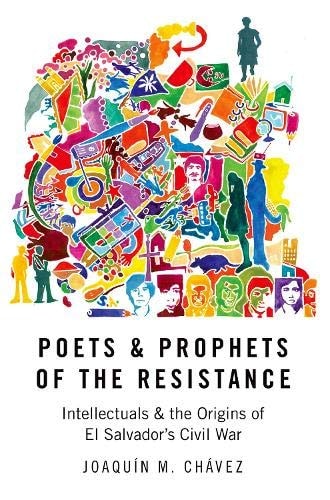
Poets and Prophets of the Resistance: Intellectuals and the Origins of El Salvador's Civil War
0
0
As an Amazon Associate and affiliate partner, Menrva Books earns from qualifying purchases. Learn more
Author Description
Poets and Prophets of the Resistance offers a ground-up history and fresh interpretation of the polarization and mobilization that brought El Salvador to the eve of civil war in 1980. Challenging the dominant narrative that university students and political dissidents primarily formed the Salvadoran guerrillas, Joaquín Chávez argues that El Salvador's socioeconomic and political crises of the 1970s fomented a groundswell of urban and peasant intellectuals who collaborated to spur larger revolutionary social movements.Drawing on new archival sources and in-depth interviews, Poets and Prophets of the Resistance contests the idea that urban militants and Roman Catholic priests influenced by Liberation Theology single-handedly organized and politicized peasant groups. Chávez shows instead how peasant intellectuals acted as political catalysts among their own communities first, particularly in the region of Chalatenango, laying the groundwork for the peasant movements that were to come. In this way, he contends, the Salvadoran insurgency emerged in a dialogue between urban and peasant intellectuals working together to create and execute a common revolutionary strategy--one that drew on cultures of resistance deeply rooted in the country's history, poetry, and religion. Focusing on this cross-pollination, this book introduces the idea that a "pedagogy of revolution" originated in this historical alliance between urban and peasant, making use of secular and Catholic pedagogies such as radio schools, literacy programs, and rural cooperatives. This pedagogy became more and more radicalized over time as it pushed back against the increasingly repressive structures of 1970s El Salvador.Teasing out the roles of little-known groups such as the politically active "La Masacuata" literary movement, the contributions of Catholic Action intellectuals to the New Left, and the overlooked efforts of peasant leaders, Poets and Prophets of the Resistance demonstrates how trans-class polit
Menrva's Summary
THE THESIS
This book investigates how a collaborative alliance between urban and peasant intellectuals catalyzed the revolutionary social movements that preceded the Salvadoran Civil War. Joaquín M. Chávez, a historian specializing in Central American politics, utilizes previously untapped archival materials and extensive oral history interviews to challenge traditional top-down interpretations of the conflict. He argues that the insurgency was not merely the product of urban militants or clergy, but rather the result of a sophisticated, cross-class pedagogical strategy rooted in local culture and religious practice.
THE SCOPE MAP
What You Will Find
- Analysis of the 1970s socioeconomic and political crises in El Salvador.
- Examination of the "La Masacuata" literary movement and its political impact.
- Investigation into the role of Catholic Action and Liberation Theology in rural organizing.
- Documentation of the "pedagogy of revolution" through radio schools and literacy programs.
Scope Limits
- The study focuses primarily on the period leading up to 1980 and does not provide a comprehensive military history of the ensuing civil war.
- The analysis is geographically centered on specific regions, particularly Chalatenango, rather than providing an exhaustive national survey of every insurgent faction.
THE AUTHORITY PERSPECTIVE
Scholars in the field of Latin American studies recognize this work as a significant contribution to understanding the intellectual origins of revolutionary movements. Readers frequently note the academic rigor of the prose and the author's success in elevating the voices of previously overlooked peasant leaders.
Page Count:
336
Publication Date:
2019-09-01
Publisher:
Oxford University Press
ISBN-10:
0190067675
ISBN-13:
9780190067670
History
West Indies
Government Resistance To
Peasants
El Salvador
Americas
World
Military
Intellectuals
Civil War
New Used & Rental Textbooks
American History
Central America
Intellectual History
Political Aspects
Community Tags
Similar Books