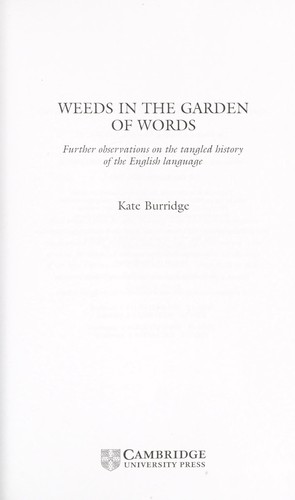
Weeds in the Garden of Words: Further Observations on the Tangled History of English Language
0
0
As an Amazon Associate and affiliate partner, Menrva Books earns from qualifying purchases. Learn more
Author Description
If the English language is a glorious garden, filled with exotic hybrids and the continuing tradition of heritage specimens, then it is no surprise that we will also find some weeds. Linguistic weeds may have pronunciations we don't want or constructions that are out of place. We may be trying to hold on to words and usage we should perhaps have said farewell to. But as all gardeners know, what one gardener calls a 'weed', another may call a 'flower'. The some goes for words and their usage in English - sometimes we just haven't realized their virtues.--BOOK JACKET.
Menrva's Summary
THE THESIS
The book investigates the contentious nature of linguistic change and the subjective perception of language 'purity'. Kate Burridge, a noted linguist, examines the historical evolution of the English language, focusing on elements often dismissed as 'weeds' or errors. She argues that what is deemed incorrect or undesirable usage frequently possesses hidden virtues or represents natural linguistic development. The book explores how societal attitudes and prescriptive grammar have shaped our understanding of language, often overlooking the dynamic and adaptive qualities of communication.
THE SCOPE MAP
- What You Will Find:
- Analysis of commonly criticized English words and grammatical constructions.
- Historical context for the evolution of linguistic 'norms'.
- Exploration of prescriptive versus descriptive approaches to language.
- Discussion on the subjective nature of judging language usage as 'correct' or 'incorrect'.
THE AUTHORITY PERSPECTIVE
The book is likely to appeal to readers interested in the history and evolution of the English language, particularly those who enjoy linguistic debates. Burridge's approach, as suggested by the description, offers a nuanced perspective that challenges traditional notions of correctness. The work appears to provide an accessible yet insightful examination of how language changes and how these changes are perceived by its speakers, likely fostering a greater appreciation for linguistic diversity.
Page Count:
196
Publication Date:
2010-01-01
ISBN-10:
0521618231
History
Non-Fiction
Language
Linguistics
Community Tags
Similar Books