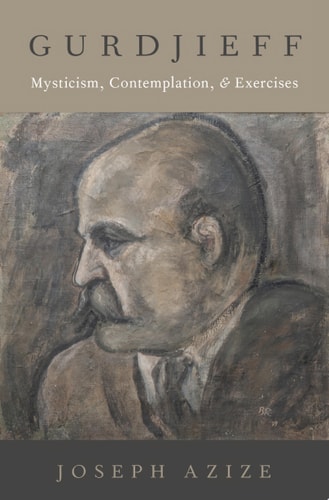
Gurdjieff: Mysticism, Contemplation, and Exercises
0
0
As an Amazon Associate and affiliate partner, Menrva Books earns from qualifying purchases. Learn more
Author Description
The Armenian-born mystic, philosopher, and spiritual teacher G. I. Gurdjieff (c.1866-1949) is an enigmatic figure, the subject of a great deal of interest and speculation, but not easily fitting into any of the common categories of "esoteric," "occult," or "New Age." Scholars have for the most part passed over in silence the contemplative exercises presented in Gurdjieff's writings. Although Gurdjieff had intended them to be confidential, some of the most important exercises were published posthumously in 1950 and in 1975.Arguing that an understanding of these exercises is necessary to fully appreciate Gurdjieff's contribution to modern esotericism, Joseph Azize offers the first complete study of the exercises and their theoretical foundation. It shows the continuity in Gurdjieff's teaching, but also the development and change. His original contribution to Western Esotericism lay in his use of tasks, disciplines, and contemplation-like exercises to bring his pupils to a sense of their own presence which could to some extent be maintained in daily life in the social domain, and not only in the secluded conditions typical of meditation. Azize contends that Gurdjieff had initially intended not to use contemplation-like exercises, as he perceived dangers to be associated with these monastic methods, and the religious tradition to be in tension with the secular and supra-denominational guise in which he first couched his teaching. As Gurdjieff adapted the teaching he had found in Eastern monasteries to Western urban and post-religious culture, however, he found it necessary to introduce contemplation.
Menrva's Summary
THE THESIS
This work investigates the role and evolution of contemplative exercises within the teachings of G. I. Gurdjieff, questioning how these practices function as a bridge between traditional monastic methods and modern secular life. Joseph Azize, a scholar of Western esotericism, utilizes a rigorous analytical framework to examine Gurdjieff's posthumously published writings. He argues that these exercises are not merely peripheral but are central to understanding Gurdjieff's unique contribution to spiritual practice in the twentieth century.
THE SCOPE MAP
What You Will Find
- A comprehensive analysis of Gurdjieff's contemplative exercises and their theoretical foundations.
- An examination of the historical development and adaptation of Gurdjieff's teaching methods.
- A study of the transition from monastic-style seclusion to social-domain presence.
Scope Limits
- The book does not provide a general biography of Gurdjieff's life outside of his spiritual teaching.
- It does not serve as a practical manual for performing the exercises without contextual study.
THE AUTHORITY PERSPECTIVE
Scholars and practitioners recognize this text as a significant contribution to the academic study of Gurdjieff, noting its focus on previously overlooked primary sources. Readers frequently highlight the academic density of the prose, which provides a structured, scholarly examination of a subject often clouded by speculation.
Page Count:
352
Publication Date:
2020-01-13
Publisher:
Oxford University Press
ISBN-10:
0190064072
ISBN-13:
9780190064075
Biography
Spirituality
Philosophy
Mysticism
New Used & Rental Textbooks
New Age
Mind & Body
Community Tags
Similar Books