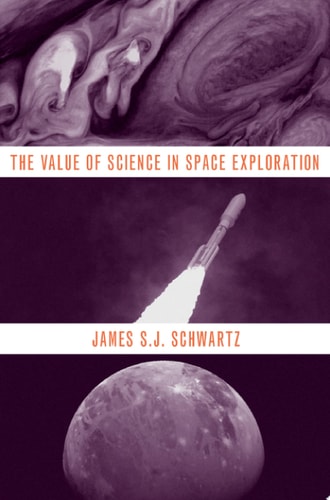
The Value of Science in Space Exploration
0
0
As an Amazon Associate and affiliate partner, Menrva Books earns from qualifying purchases. Learn more
Author Description
Space exploration, especially the recent push for the commercialization and militarization of space, is attracting increased attention not only from the wider public and the private sector but also from scholars in a wide range of disciplines. At this moment of uncertainty about the future direction of national spaceflight programs, The Value of Science in Space Exploration defends the idea, often overlooked, that the scientific understanding of the Solar System is both intrinsically and instrumentally valuable. Drawing on research from the physical sciences, social sciences, and the humanities, James S.J. Schwartz argues further that there is truly a compelling obligation to improve upon our scientific understanding-including our understanding of space environments-and that there exists a corresponding duty to engage in the scientific exploration of the Solar System.After outlining the underpinning epistemological debates, Schwartz tackles how this obligation affects the way we should approach some of the major questions of contemporary space science and policy: Is there a need for environmental preservation in space? Should humans try to establish settlements on the Moon, Mars, or elsewhere in the Solar System, and if so, how? In answering these questions, Schwartz parleys with recent work in science policy and social philosophy of science to characterize the instrumental value of scientific research, identifying space research as a particularly effective generator of new knowledge. Additionally, whereas planetary protection policies are currently employed to prevent biological contamination only of sites of interest in the search for extraterrestrial life, Schwartz contends that all sites of interest to space science ought to be protected. Meanwhile, both space resource exploitation, such as lunar or asteroid mining, and human space settlement would result in extensive disruption or destruction of pristine space environments. The overall ethical value of these en
Menrva's Summary
THE THESIS
This book investigates the ethical and epistemological justifications for prioritizing scientific research within the context of modern space exploration. James S.J. Schwartz, a scholar in the philosophy of science, synthesizes perspectives from the physical sciences, social sciences, and humanities to argue that humanity possesses a moral obligation to explore the Solar System. He posits that scientific understanding holds both intrinsic and instrumental value, which should serve as the primary guiding principle for national and commercial space policies.
THE SCOPE MAP
What You Will Find
- Philosophical frameworks regarding the intrinsic versus instrumental value of scientific knowledge.
- Analysis of planetary protection policies and the ethics of environmental preservation in space.
- Ethical evaluations of space resource exploitation, such as asteroid mining, and human settlement.
Scope Limits
- The text does not provide technical engineering specifications for space travel or hardware.
- It does not focus on the geopolitical history of the Cold War space race, but rather on contemporary and future policy implications.
THE AUTHORITY PERSPECTIVE
Scholars in the field of space ethics identify this work as a rigorous contribution to the philosophy of science and policy discourse. Readers frequently note the academic density of the prose, which effectively bridges the gap between abstract ethical theory and practical space governance.
Page Count:
272
Publication Date:
2020-04-01
Publisher:
Oxford University Press
ISBN-10:
0190069066
ISBN-13:
9780190069063
Philosophy
Politics
Value
SCIENCE Astronomy
Science Policy
Epistemology
Exploration
Astronautics
Ethics
New Used & Rental Textbooks
Aerospace
Engineering
Social Science
Science & Math
Community Tags
Similar Books