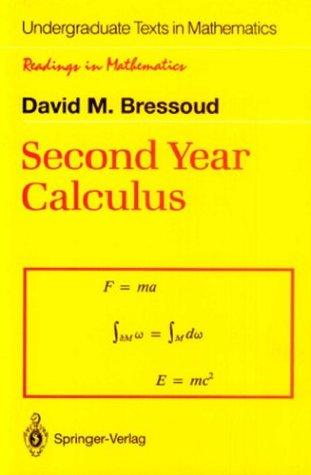
Second Year Calculus
0
0
As an Amazon Associate and affiliate partner, Menrva Books earns from qualifying purchases. Learn more
Author Description
Second Year Calculus: From Celestial Mechanics to Special Relativity covers multi-variable and vector calculus, emphasizing the historical physical problems which gave rise to the concepts of calculus. The book carries us from the birth of the mechanized view of the world in Isaac Newton's Mathematical Principles of Natural Philosophy in which mathematics becomes the ultimate tool for modelling physical reality, to the dawn of a radically new and often counter-intuitive age in Albert Einstein's Special Theory of Relativity in which it is the mathematical model which suggests new aspects of that reality. The development of this process is discussed from the modern viewpoint of differential forms. Using this concept, the student learns to compute orbits and rocket trajectories, model flows and force fields, and derive the laws of electricity and magnetism. These exercises and observations of mathematical symmetry enable the student to better understand the interaction of physics and mathematics.
Menrva's Summary
THE THESIS
This book investigates the historical development and application of multivariable and vector calculus, tracing its roots from classical mechanics to modern relativity. The author, David M. Bressoud, utilizes historical physical problems to illuminate the concepts of calculus, beginning with Newton's modeling of the physical world and progressing to Einstein's theories of relativity. The text employs the modern viewpoint of differential forms to enable students to compute orbits, model flows, and derive fundamental laws of physics, thereby fostering a deeper understanding of the interplay between mathematics and physics.
THE SCOPE MAP
- Covers multivariable and vector calculus.
- Emphasizes historical physical problems that motivated calculus concepts.
- Traces the evolution of mathematical modeling from Newton to Einstein.
- Utilizes differential forms as a unifying concept.
- Includes applications in computing orbits and rocket trajectories.
- Demonstrates modeling of flows and force fields.
- Derives the laws of electricity and magnetism.
- Highlights mathematical symmetry and its interaction with physics.
THE AUTHORITY PERSPECTIVE
The book is structured to connect advanced mathematical concepts with their historical physical origins, suggesting a pedagogical approach that bridges theoretical understanding with practical application. Its focus on differential forms indicates a rigorous treatment suitable for students seeking a comprehensive grasp of calculus's role in physics. The historical narrative aims to provide context and motivation for the mathematical tools developed.
Page Count:
386
Publication Date:
1991-01-01
ISBN-10:
038797606X
Non-Fiction
Science
History
Mechanics
Calculus
Physics
Community Tags
Similar Books