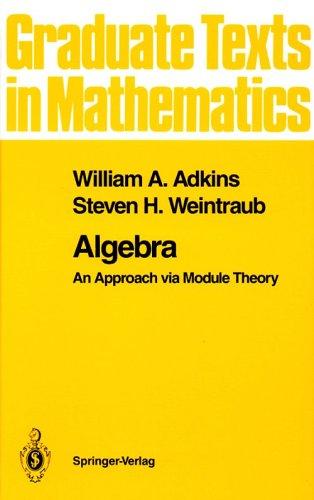
Algebra
0
0
As an Amazon Associate and affiliate partner, Menrva Books earns from qualifying purchases. Learn more
Author Description
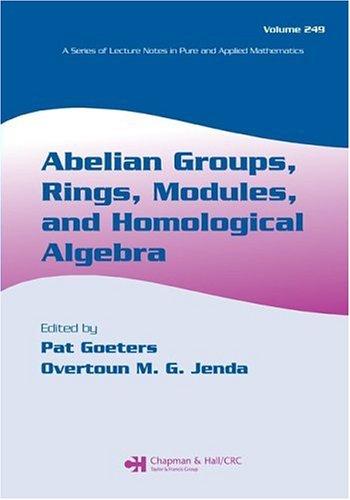
This book is designed as a text for a first-year graduate algebra course. The choice of topics is guided by the underlying theme of modules as a basic unifying concept in mathematics. Beginning with standard topics in groups and ring theory, the authors then develop basic module theory, culminating in the fundamental structure theorem for finitely generated modules over a principal ideal domain. They then treat canonical form theory in linear algebra as an application of this fundamental theorem. Module theory is also used in investigating bilinear, sesquilinear, and quadratic forms. The authors develop some multilinear algebra (Hom and tensor product) and the theory of semisimple rings and modules and apply these results in the final chapter to study group represetations by viewing a representation of a group G over a field F as an F(G)-module. The book emphasizes proofs with a maximum of insight and a minimum of computation in order to promote understanding. However, extensive material on computation (for example, computation of canonical forms) is provided.
Menrva's Summary
THE THESIS
This text investigates the fundamental structure of algebraic concepts, particularly focusing on modules as a unifying theme. The book is designed for a first-year graduate algebra course, beginning with standard group and ring theory before developing module theory. It culminates in the structure theorem for finitely generated modules over principal ideal domains, with applications in linear algebra, bilinear forms, and group representations. The authors prioritize proofs that offer maximum insight with minimum computation, though computational examples are also provided.
THE SCOPE MAP
- What You Will Find:
- Development of basic module theory as a unifying concept.
- Treatment of canonical form theory in linear algebra as an application of module theory.
- Investigation of bilinear, sesquilinear, and quadratic forms using module theory.
- Exploration of multilinear algebra (Hom and tensor product).
- Study of semisimple rings and modules.
- Application of results to group representations by viewing them as F(G)-modules.
- Emphasis on proofs for insight and understanding, supplemented with computational material.
THE AUTHORITY PERSPECTIVE
The book is structured as a graduate-level text, indicating a dense and rigorous approach to abstract algebra. Its focus on modules as a central theme suggests a coherent and theoretically driven exploration of the subject matter. The inclusion of applications in linear algebra and group theory points to a comprehensive scope for advanced students. The emphasis on insightful proofs over extensive computation aims to foster a deep understanding of the underlying mathematical principles.
Page Count:
526
Publication Date:
1999-01-01
ISBN-10:
0387978399
ISBN-13:
9780387978390
Non-Fiction
Science
Mathematics
Algebra
Community Tags
Similar Books