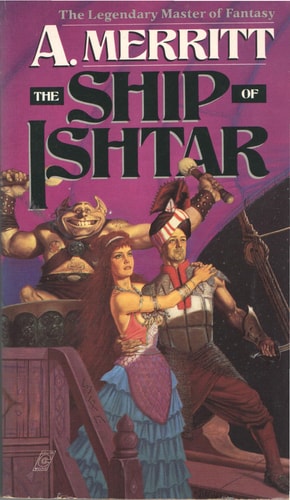
The Ship of Ishtar
0
0
As an Amazon Associate and affiliate partner, Menrva Books earns from qualifying purchases. Learn more
Author Description
The Ship of Ishtar, a universally hailed classic of the fantasy novel by A. Merritt. Abraham Grace Merritt (January 20, 1884-August 21, 1943) - known by his byline, A. Merritt - was an American editor and author of works of fantastic fiction. Merritt's writings were heavily influenced by H. Rider Haggard and Gertrude Barrows Bennett (writing as Francis Stevens), with Merritt having "emulated Bennett's earlier style and themes." Merritt's stories typically revolve around conventional pulp magazine lost civilizations, hideous monsters, etc. His heroes are gallant Irishmen or Scandinavians, his villains treacherous Germans or Russians (in accordance with the politics of the time) and his heroines often virginal, mysterious and scantily clad. What sets Merritt apart from the typical pulp author, however, is his lush, florid prose style and his exhaustive, at times exhausting, penchant for adjective-laden detail. Merritt's fondness for micro-description nicely complements the pointillistic style of Bok's illustrations, and often serves to highlight and radicalize the inherent fetishistic tendencies of pulp Sci Fi.
Menrva's Summary
THE PULSE
A modern man is thrust into a supernatural conflict when he discovers an ancient, cursed artifact that transports him to a vessel sailing upon a mystical sea. John Kenton finds himself aboard the Ship of Ishtar, a floating sanctuary caught in a perpetual war between the goddess Ishtar and the god Nergal. He must navigate the treacherous politics of the ship's crew and the supernatural forces vying for control of the vessel. The narrative utilizes a portal-fantasy framework to contrast the mundane reality of the protagonist with the high-stakes, mythic environment of the ship. Kenton faces physical threats from monstrous entities and logical constraints imposed by the divine rules governing the ship's existence.
INSIDE THE PAGES
- Lush, florid prose style characteristic of early twentieth-century pulp literature
- Exploration of ancient mythological archetypes and deities
- High-stakes conflict between opposing supernatural forces
- Vivid, adjective-laden descriptions of exotic settings and creatures
- Protagonist archetype rooted in the gallant adventurer tradition
- Integration of mysterious, ethereal heroines
- Pacing driven by constant external threats and shifting alliances
- Atmospheric world-building centered on the isolated, ship-bound environment
THE COLLECTIVE ECHO
Readers frequently highlight the ornate and descriptive prose style that defines Merritt's approach to world-building. Discussion often centers on the contrast between the fast-paced action typical of pulp magazines and the author's tendency toward dense, sensory-rich passages. Critics note that the work serves as a prime example of early fantasy conventions, particularly in its use of lost civilizations and mythological conflict. The balance of character development is often secondary to the atmospheric immersion and the imaginative scope of the setting. Readers who appreciate classic, stylized fantasy often find the work a significant artifact of the genre's formative period.
Page Count:
309
Publication Date:
1991-05-01
Publisher:
Collier Books
ISBN-10:
0020228716
ISBN-13:
9780020228714
Adventure
Fantasy
Pulp Fiction
Short Stories
Classic Fantasy
Lost World
United States
Science Fiction
Community Tags
Similar Books