Citizens, Courts, and Confirmations
0
0
As an Amazon Associate and affiliate partner, Menrva Books earns from qualifying purchases. Learn more
Author Description
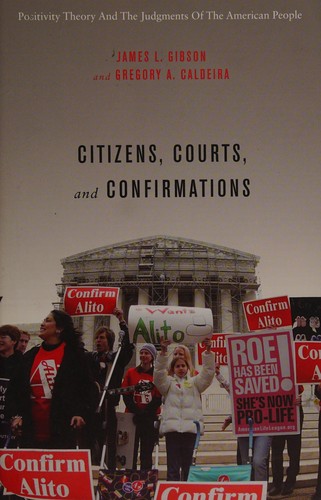
In recent years the American public has witnessed several hard-fought battles over nominees to the U.S. Supreme Court. In these heated confirmation fights, candidates' legal and political philosophies have been subject to intense scrutiny and debate. Citizens, Courts, and Confirmations examines one such fight--over the nomination of Samuel Alito--to discover how and why people formed opinions about the nominee, and to determine how the confirmation process shaped perceptions of the Supreme Court's legitimacy. Drawing on a nationally representative survey, James Gibson and Gregory Caldeira use the Alito confirmation fight as a window into public attitudes about the nation's highest court. They find that Americans know far more about the Supreme Court than many realize, that the Court enjoys a great deal of legitimacy among the American people, that attitudes toward the Court as an institution generally do not suffer from partisan or ideological polarization, and that public knowledge enhances the legitimacy accorded the Court. Yet the authors demonstrate that partisan and ideological infighting that treats the Court as just another political institution undermines the considerable public support the institution currently enjoys, and that politicized confirmation battles pose a grave threat to the basic legitimacy of the Supreme Court.
Menrva's Summary
THE THESIS
This book investigates how public opinion and partisan conflict shape perceptions of the U.S. Supreme Court's legitimacy, using the Samuel Alito confirmation as a case study. The authors draw on a nationally representative survey to explore how citizens formed opinions about Alito and how the confirmation process itself influenced views of the Court. They argue that despite partisan polarization, the public generally holds a high regard for the Court's legitimacy, and that public knowledge of the Court enhances this legitimacy. However, the study also demonstrates that intense partisan battles, which treat the Court as a political institution, erode this support and pose a significant threat to the Court's fundamental legitimacy.
THE SCOPE MAP
- Analysis of the Samuel Alito Supreme Court nomination confirmation process.
- Examination of how citizens form opinions about Supreme Court nominees.
- Assessment of the impact of confirmation battles on the Supreme Court's legitimacy.
- Findings from a nationally representative survey on public attitudes toward the Court.
- Discussion on the relationship between public knowledge and the Court's legitimacy.
- Exploration of partisan and ideological polarization in relation to the Supreme Court.
- Argument that politicized confirmation processes undermine public support for the judiciary.
THE AUTHORITY PERSPECTIVE
The book is regarded as a significant contribution to the study of judicial politics and public opinion. Scholars have noted its rigorous empirical approach, utilizing survey data to provide concrete evidence for its claims about public knowledge and the Court's legitimacy. The analysis of the Alito confirmation is seen as a valuable lens through which to understand broader trends in the politicization of judicial appointments. The authors' conclusions highlight the delicate balance between public engagement and the potential for partisan conflict to damage institutional trust in the Supreme Court.
Page Count:
178
Publication Date:
2009-01-01
ISBN-10:
0691139873
ISBN-13:
9780691139876
History
Politics
Non-Fiction
Supreme Court
American Politics
Public opinion
Law
Community Tags
Similar Books