Solar Lottery
0
0
As an Amazon Associate and affiliate partner, Menrva Books earns from qualifying purchases. Learn more
Author Description
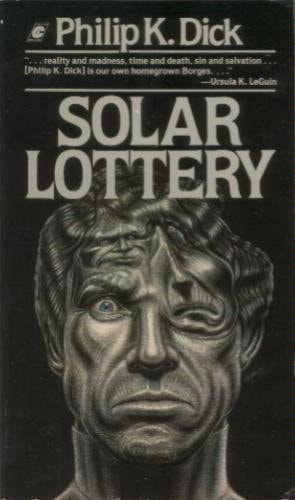
THE ULTIMATE LOTTO GAME! The year is 2203 and the Earth is governed by a bizarre system of random selection wherein public officeholders and the victims of political assassination alike are chosen by the luck of a mad draw. In this maniacal world Ted Benteley is an ordinary guy with an extraordinary job. Working at the Solar Lottery he becomes a pawn in a power struggle that changes his life forever, and the direction of his century's history. Although Benteley doesn't realize it at first, by saying no to the inhuman system he has challenged the most diabolical power broker of the age to a winner-take-all duel of psychic trickery. Solar Lottery was Philip K. Dick's first novel, published in 1955. Dick was one of the foremost exponents of psychologically intense science fiction, as exemplified in his Eye in the Sky, which is also part of the Collier Nucleus Series. His career spanned the early 1950s until his death in 1982, during which time he published twenty-five novels. "Excellent, idiosyncratic, [a] formidably intelligent writer—a cult figure in the world of science fiction." —The Washington Post Book World. "…reality and madness, time and death, sin and salvation…[Philip K. Dick] is our own homegrown Borges…" —Ursala K. LeGuin
Menrva's Summary
THE PULSE
In a future where political power is determined by a randomized lottery system, a man finds himself caught in a high-stakes struggle against a ruthless power broker. Ted Benteley, an ordinary employee within the Solar Lottery administration, becomes an unwitting participant in a complex political game. As he navigates the rigid, arbitrary structures of a society governed by chance, he faces opposition from figures who manipulate the system to maintain control. The narrative follows his attempts to resist the dehumanizing effects of this lottery, forcing him into a confrontation that tests his survival and moral resolve. The story is presented through a third-person perspective that emphasizes the absurdity of the world's governing mechanisms.
INSIDE THE PAGES
- Exploration of a randomized political selection system
- Focus on the intersection of bureaucracy and individual agency
- Inclusion of psychic phenomena as a strategic tool
- Examination of power dynamics in a futuristic society
- Portrayal of a rigid, dystopian social hierarchy
- Use of satirical elements to critique political structures
- Emphasis on the psychological pressure of living under arbitrary rules
- Development of a high-stakes conflict between an ordinary citizen and a powerful antagonist
THE COLLECTIVE ECHO
Readers frequently highlight this work as a foundational example of the author's early interest in the instability of reality and political systems. Discussion often centers on the effectiveness of the lottery premise as a vehicle for exploring themes of control and individual autonomy. Critics note the presence of idiosyncratic elements that would later define the author's more mature science fiction output. The pacing is often described as brisk, focusing more on the mechanics of the world-building than on extensive character interiority. Many readers appreciate the intellectual rigor applied to the concept of a society governed by pure chance.
Page Count:
188
Publication Date:
1990-01-01
Publisher:
Collier Books
ISBN-10:
0020291256
ISBN-13:
9780020291251
Dystopian
Science Fiction
Political fiction
Science Fiction