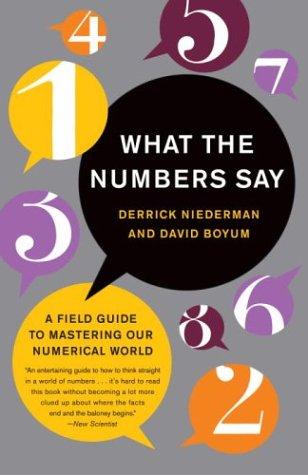
What the Numbers Say
0
0
As an Amazon Associate and affiliate partner, Menrva Books earns from qualifying purchases. Learn more
Author Description
Offers a series of clear, comprehensible techniques to help readers understand, process, and calculate their way through the vast amount of quantitative data that exists, presenting a series of real-world situations, ranging from stock market probability and interest rate percentages to political polls and sports scoring. Our society is churning out more numbers than ever before, whether in the form of spreadsheets, brokerage statements, survey results, or just the numbers on the sports pages. Unfortunately, people's ability to understand and analyze numbers isn't keeping pace with today's whizzing data streams. And the benefits of living in the Information Age are available only to those who can process the information in front of them. What the Numbers Say offers remedies to this national problem. Through a series of witty and engaging discussions, the authors introduce original quantitative concepts, skills, and habits that reduce even the most daunting numerical challenges to simple, bite-sized pieces. Why do the nutritional values on a Cheerios box appear different in Canada than in the U.S.? How is it that top-performing mutual funds often lose money for the majority of their shareholders? Why was the scoring system for Olympic figure skating doomed even without biased judges? By anchoring their discussions in real-world scenarios, Derrick Niederman and David Boyum show that skilled quantitative thinking involves old-fashioned logic, not advanced mathematical tools. Useful in an endless number of situations, What the Numbers Say is the practical guide to navigating today's data-rich world.
Menrva's Summary
THE THESIS
This book equips readers with the essential skills to decipher and utilize the overwhelming amount of quantitative data encountered daily. The authors, Derrick Niederman and David Boyum, address the growing gap between the proliferation of numerical information and the public's ability to process it. Through engaging discussions grounded in real-world examples, they introduce practical quantitative concepts and habits that simplify complex numerical challenges, demonstrating that logical reasoning, rather than advanced mathematics, is key to understanding data.
THE SCOPE MAP
- Explanation of techniques for understanding, processing, and calculating quantitative data.
- Analysis of real-world situations including stock market probability, interest rates, political polls, and sports scoring.
- Discussion on how to interpret numerical data presented in various formats like spreadsheets, statements, and survey results.
- Exploration of original quantitative concepts and skills to break down daunting numerical challenges.
- Case studies addressing discrepancies in nutritional values across different countries and performance of mutual funds.
- Examination of scoring systems, using Olympic figure skating as an example.
- Emphasis on the application of logic and critical thinking over advanced mathematical tools for quantitative analysis.
THE AUTHORITY PERSPECTIVE
The book is presented as a practical guide for navigating a data-rich world, aiming to demystify numbers for the general reader. Its approach emphasizes logical reasoning and practical application, suggesting it would appeal to individuals seeking to improve their quantitative literacy without needing advanced mathematical backgrounds. The real-world examples are intended to make complex topics accessible and relevant to everyday life.
Page Count:
288
Publication Date:
2004-01-01
ISBN-10:
0767909992
ISBN-13:
9780767909990
Non-Fiction
Self-help
Critical thinking
Data Literacy
Community Tags
Similar Books