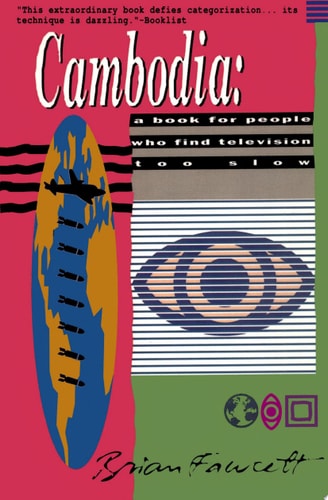
Cambodia: A Book For People Who Find Television Too Slow
0
0
As an Amazon Associate and affiliate partner, Menrva Books earns from qualifying purchases. Learn more
Author Description
Brian Fawcett pens a ferociously brilliant book that is sure to challenge readers to see the world through a new set of eyes in his “ringing call for… a self-liberation through the very acts of remembering and imagining” (Los Angeles Times).Through thirteen wildly imaginative short stories and a passional essay on colonialism and Southeast Asia, Cambodia: A Book for People Who Find Television Too Slow startles, amuses, and infuriates its readers with juxtaposed images and penetrating insights into the media jungle.Like subtitles read in a foreign film, the pace of Brian Fawcett’s intoxicating prose accelerates quickly and unfolds right before the readers eyes until it is moving more swiftly than the imagines on the evening moves.Passion stirs in the pages of Fawcett’s book, urging readers to resist the annihilation of memory and imagination in our society.
Menrva's Summary
THE PULSE
The central conflict arises from the tension between the rapid, fragmented nature of modern media consumption and the necessity of historical memory in understanding global political realities.
Fawcett presents a hybrid narrative structure that alternates between thirteen short stories and a central essay to challenge the reader's perception of Southeast Asian history and Western media influence. The protagonist—often a stand-in for the reader or the author—attempts to reconcile the sanitized, fast-paced images of television with the complex, often brutal realities of colonialism and conflict in Cambodia. The narrative framework utilizes a non-linear, experimental approach, forcing the reader to navigate between fictionalized accounts and analytical prose to construct a coherent understanding of the subject matter.
INSIDE THE PAGES
- Hybrid structure combining short fiction and non-fiction essays
- Juxtaposition of disparate images to create cognitive dissonance
- Meta-commentary on the speed and superficiality of television news
- Exploration of the intersection between personal memory and historical record
- Critique of Western colonial perspectives in Southeast Asia
- Experimental prose style designed to mimic and subvert media pacing
- Use of footnotes or subtitle-like narrative devices
- Focus on the erosion of individual imagination in a media-saturated society
THE COLLECTIVE ECHO
Readers and critics frequently describe this work as a challenging, unconventional text that demands active participation from the audience. Discussion often centers on the effectiveness of the book's dual-format structure, with many noting how the juxtaposition of fiction and essay creates a unique reading rhythm. Critics highlight the author's aggressive critique of media consumption, often comparing the prose style to the rapid-fire nature of television broadcasts. The work is widely recognized for its ability to provoke strong reactions, ranging from intellectual engagement to frustration with its fragmented delivery. Readers who appreciate experimental literature and social critique often find the book's unconventional approach to be a significant strength in its thematic delivery.
Page Count:
224
Publication Date:
1989-10-25
Publisher:
Touchstone
ISBN-10:
0020321503
ISBN-13:
9780020321507
Literary Fiction
Media Studies
Social Commentary
History General
Political
Short Stories
Postmodern
Essays
Reference
Community Tags
Similar Books