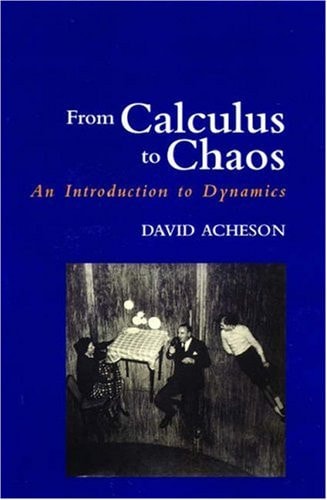
From Calculus to Chaos: An Introduction to Dynamics
0
0
As an Amazon Associate and affiliate partner, Menrva Books earns from qualifying purchases. Learn more
Author Description
What is calculus really for? This book is a highly readable introduction to applications of calculus, from Newton's time to the present day. These often involve questions of dynamics, i.e., of how--and why--things change with time. Problems of this kind lie at the heart of much of applied mathematics, physics, and engineering. From Calculus to Chaos takes a fresh approach to the subject as a whole, by moving from first steps to the frontiers, and by focusing on the many important and interesting ideas which can get lost amid a snowstorm of detail in conventional texts. The book is aimed at a wide readership, and assumes only some knowledge of elementary calculus. There are exercises (with full solutions) and simple but powerful computer programs which are suitable even for readers with no previous computing experience. David Acheson's book will inspire new students by providing a foretaste of more advanced mathematics and some of its liveliest applications.
Menrva's Summary
THE THESIS
This book investigates the practical utility and conceptual beauty of calculus by exploring its role in understanding dynamic systems. David Acheson, a mathematician with extensive experience in pedagogical communication, utilizes a historical and application-focused framework to bridge the gap between elementary calculus and advanced dynamics. By stripping away excessive technical abstraction, he presents the core principles of change and motion that underpin modern physics and engineering. The text serves as a bridge for students and enthusiasts to transition from basic differentiation and integration to the study of complex, chaotic systems.
THE SCOPE MAP
What You Will Find
- Historical development of calculus from Newton to modern dynamics
- Practical applications of differential equations in physics and engineering
- Introduction to chaos theory and non-linear systems
- Exercises with full solutions and accessible computer programming examples
THE AUTHORITY PERSPECTIVE
Experts and educators frequently cite this work as a highly accessible entry point for students seeking to understand the real-world utility of mathematics. Readers often note that the prose is remarkably clear, successfully avoiding the dense, overwhelming detail found in traditional academic textbooks.
Page Count:
278
Publication Date:
1998-01-08
Publisher:
Oxford University Press
ISBN-10:
0198502575
ISBN-13:
9780198502579
Chaotic behavior in systems
Mathematics
Applied Mathematics
Physics
Dynamics
Calculus
Engineering
Community Tags
Similar Books