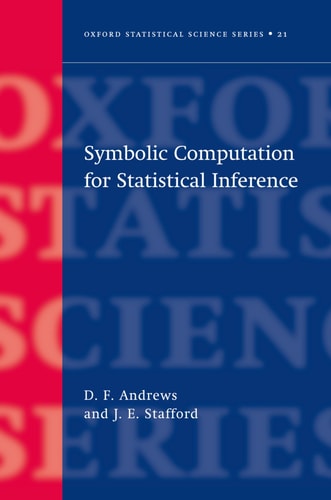
Symbolic Computation for Statistical Inference
0
0
As an Amazon Associate and affiliate partner, Menrva Books earns from qualifying purchases. Learn more
Author Description
Over recent years, developments in statistical computing have freed statisticians from the burden of calculation and have made possible new methods of analysis that previously would have been too difficult or time-consuming. Up till now these developments have been primarily in numerical computation and graphical display, but equal steps forward are now being made in the area of symbolic computing: the use of computer languages and procedures to manipulate expressions. This allows researchers to compute an algebraic expression, rather than evaluate the expression numerically over a given range. This book summarizes a decade of research into the use of symbolic computation applied to statistical inference problems. It shows the considerable potential of the subject to automate statistical calculation, leaving researchers free to concentrate on new concepts. Starting with the development of algorithms applied to standard undergraduate problems, the book then goes on to develop increasingly more powerful tools. Later chapters then discuss the application of these algorithms to different areas of statistical methodology.
Menrva's Summary
THE THESIS
This book investigates the application of symbolic computation to automate and enhance statistical inference, moving beyond traditional numerical methods. Authors D. F. Andrews and J. E. Stafford leverage a decade of research to demonstrate how computer languages can manipulate algebraic expressions directly. By shifting the focus from numerical evaluation to symbolic manipulation, the text provides a framework for researchers to automate complex calculations and prioritize conceptual development in statistical methodology.
THE SCOPE MAP
What You Will Find
- Development of algorithms for standard undergraduate statistical problems
- Methodologies for algebraic expression manipulation in statistical contexts
- Progressive scaling of computational tools from basic to advanced applications
- Case studies demonstrating the application of symbolic computation to diverse statistical methodologies
THE AUTHORITY PERSPECTIVE
Experts recognize this text as a foundational resource for understanding the integration of symbolic computing into statistical research. Readers frequently note the technical density of the prose, which serves as a specialized guide for statisticians seeking to automate complex analytical workflows.
Page Count:
176
Publication Date:
2000-08-24
Publisher:
Oxford University Press
ISBN-10:
0198507054
ISBN-13:
9780198507055
Algorithms
Computer Science
Statistics
Data Analysis
Mathematics
Community Tags
Similar Books