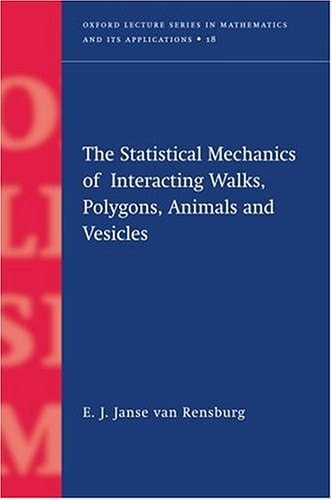
Statistical Mechanics of Interacting Walks, Polygons, Animals and Vesicles
0
0
As an Amazon Associate and affiliate partner, Menrva Books earns from qualifying purchases. Learn more
Author Description
This book surveys and explains the mathematical methods and techniques used in the study of lattice models of polymers in solvents. The techniques include the self-avoiding walk and its related models including animal and tree graphs, surfaces and vesicles and directed models. The important feature in all these models is the contribution of conformational degrees of freedom to the free energy, which leads to the idea of a tricritical point. The book explores the theory of tricriticality showing how it can be used to interpret the limiting free energy and generating functions. Density function and pattern theorems are also discussed and are applied to models of collapsing and adsorbing walks, to composite polygons and crumpling surfaces.
Menrva's Summary
THE THESIS
This book investigates the mathematical properties and statistical mechanics of lattice models representing polymers, including self-avoiding walks, polygons, and vesicles. E. J. Janse van Rensburg, a specialist in the field, provides a rigorous examination of conformational degrees of freedom and their impact on free energy. The text establishes a theoretical framework for understanding tricriticality and its application to complex polymer behaviors in solvent environments.
THE SCOPE MAP
What You Will Find
- Mathematical analysis of self-avoiding walks, animal graphs, and tree structures.
- Theoretical exploration of tricritical points and their influence on limiting free energy.
- Application of pattern theorems to models of collapsing and adsorbing polymers.
- Examination of composite polygons and the physics of crumpling surfaces.
THE AUTHORITY PERSPECTIVE
Experts recognize this work as a specialized technical reference for researchers in statistical mechanics and polymer physics. Readers frequently note the high level of mathematical density and the rigorous, formal approach to lattice model analysis.
Page Count:
379
Publication Date:
2000-05-15
Publisher:
Oxford University Press
ISBN-10:
0198505612
ISBN-13:
9780198505617
Science
Mathematics
Statistical mechanics
Physics
Polymers
Community Tags
Similar Books