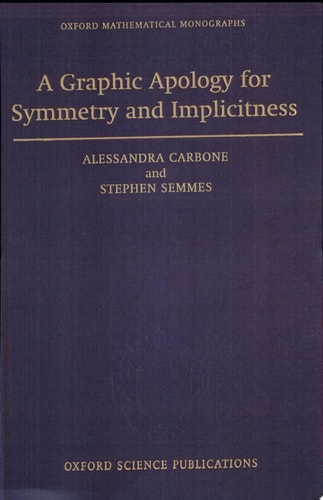
A Graphic Apology for Symmetry and Implicitness
0
0
As an Amazon Associate and affiliate partner, Menrva Books earns from qualifying purchases. Learn more
Author Description
This book brings into focus the contrast between explicit and implicit algorithmic descriptions of objects and presents a new geometric language for the study of combinatorial and logical problems in complexity theory. These themes are considered in a variety of settings, sometimes crossing traditional boundaries. Special emphasis is given to moderate complexity - exponential or polynomial - but objects with multi-exponential complexity also fit in. Among the items under consideration are graphs, formal proofs, languages, automata, groups, circuits, some connections with geometry of metric spaces, and complexity classes (P, NP, co-NP).
Menrva's Summary
THE THESIS
This book investigates the fundamental distinction between explicit and implicit algorithmic descriptions of mathematical objects and their implications for complexity theory. Authors Alessandra Carbone and Stephen Semmes utilize their expertise in geometry and logic to construct a new formal language for analyzing combinatorial problems. By examining objects ranging from graphs to formal proofs, the authors argue that a geometric approach provides a more robust framework for understanding complexity classes such as P, NP, and co-NP.
THE SCOPE MAP
What You Will Find
- Analysis of algorithmic complexity including polynomial, exponential, and multi-exponential growth.
- A geometric framework for evaluating combinatorial and logical problem structures.
- Examination of diverse mathematical objects including automata, groups, circuits, and languages.
- Theoretical connections between the geometry of metric spaces and computational complexity classes.
THE AUTHORITY PERSPECTIVE
Experts recognize this monograph as a specialized contribution to the intersection of geometry and theoretical computer science. Readers frequently note the high level of technical density, making it a resource primarily intended for researchers and advanced graduate students in mathematics.
Page Count:
520
Publication Date:
2000-08-24
Publisher:
Oxford University Press
ISBN-10:
0198507291
ISBN-13:
9780198507291
Mathematics
Graph Theory
Complexity Theory
Geometry
Computer Science
Computational complexity
Group Theory
Algorithms
Machine Theory
Community Tags
Similar Books