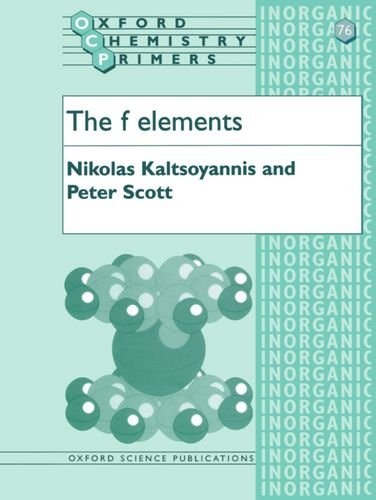
The f Elements
0
0
As an Amazon Associate and affiliate partner, Menrva Books earns from qualifying purchases. Learn more
Author Description
The lanthanides and actinides (the f elements) are rarely studied in detail by chemistry undergraduates. More often they appear as an afterthought in bonding, spectroscopy, magnetism, coordination chemistry, and organometallics courses. This is largely because of a lack of an accessible text treating the chemistry of these elements in one cover. Moreover, the placement of lanthanides and actinides in the closing pages of standard inorganic chemistry text books serves to marginalise these elements further. The f elements has therefore been written to fill a gap in the undergraduate chemistry textbook market. It covers much of the fundamental chemistry of the lanthanide and actinide elements, including coordination chemistry, solid state compounds, organometallic chemistry, electronic spectroscopy, and magnetism. Many comparisons are made between the chemistry of the lanthanides and actinides and that of the transition elements, which is generally much more familiar to undergraduate chemistry students. The book uses the chemistry of the f elements as a vehicle for the communication of several important chemical concepts that are not usually discussed in detail in undergraduate courses, for example the chemical consequences of relativity and the lanthanide and actinide contractions. Many important modern applications of f element chemistry, e.g. the use of actinides in nuclear power generation and of the lanthanides in magnetic resonance imaging and catalytic converters in motor vehicle exhausts, are also discussed in depth.
Menrva's Summary
THE THESIS
This text investigates the fundamental chemical properties and applications of the lanthanide and actinide series, addressing the historical marginalization of these elements in undergraduate curricula. Authors Nikolas Kaltsoyannis and Peter Scott provide a structured framework that synthesizes coordination chemistry, electronic structure, and relativistic effects. By comparing f-block elements to more familiar transition metals, the authors establish a pedagogical bridge for students to understand complex periodic trends and modern industrial applications.
THE SCOPE MAP
What You Will Find
- Comprehensive coverage of lanthanide and actinide coordination chemistry and solid state compounds.
- Analysis of relativistic effects and the lanthanide and actinide contractions.
- Comparative studies between f-block elements and transition metals.
- Practical applications including nuclear power, magnetic resonance imaging, and catalytic converters.
THE AUTHORITY PERSPECTIVE
Experts and educators recognize this primer as a necessary resource for filling the gap in standard inorganic chemistry literature. Students and instructors frequently note the clarity of the text in making advanced concepts like relativistic chemical consequences accessible at the undergraduate level.
Page Count:
85
Publication Date:
1999-09-23
Publisher:
Oxford University Press
ISBN-10:
0198504675
ISBN-13:
9780198504672
Science
F Layer
Chemistry
textbook
Inorganic Chemistry
Community Tags
Similar Books