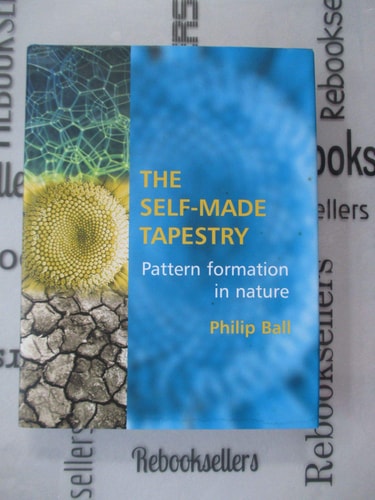
The Self-Made Tapestry: Pattern Formation in Nature
0
0
As an Amazon Associate and affiliate partner, Menrva Books earns from qualifying purchases. Learn more
Author Description
For centuries, scientists have struggled to understand the origins of the patterns and forms found in nature-from the leopards spots to the graceful spirals of a mollusc shell to the complex designs on a butterflys wing. Now, in this lucid and elegantly written book, Philip Ball applies state-of-the-art scientific understanding from the fields of biology, chemistry, geology, physics, and mathematics to these ancient mysteries, revealing how nature's seemingly complex patterns originate in simple physical laws.Ball traces the history of scientific thought about natural patterns, showing how common presumptions-for example, that complex form must be guided by some intelligence or that form always follows function-are erroneous and continue to mislead scientists today. He investigates specific patterns in depth, revealing that these designs are self-organized and that simple, local interactions between component parts produce motifs like spots, stripes, branches, and honeycombs. In the process, he examines the mysterious phenomenon of symmetry and why it appears-and breaks-in similar ways in different systems. Finally, he attempts to answer this profound question: why are some patterns universal? Illustrations throughout the text, many in full color, beautifully illuminate Ball's ideas.A fascination with nature,s patterns is as old as civilization. With this spellbinding book, Ball dispels age-old conundrums while increasing the readers wonder and appreciation for the beauty of the natural world. The Self-Made Tapestry will enlighten anyone who has ever marveled at the shape of a seashell or the brilliance of a spider's web.
Menrva's Summary
THE THESIS
This book investigates the fundamental question of how complex, ordered patterns in the natural world emerge from simple, local physical laws rather than external guidance. Philip Ball, a science writer with extensive experience in physical sciences, synthesizes research across biology, chemistry, and physics to challenge traditional assumptions about form and function. He argues that self-organization is the primary mechanism behind the recurring motifs observed in both living and non-living systems. By examining the history of scientific thought, Ball provides a framework for understanding why certain patterns, such as spirals and stripes, appear universally across diverse environments.
THE SCOPE MAP
What You Will Find
- Analysis of pattern formation mechanisms including reaction-diffusion systems and symmetry breaking.
- Historical overview of scientific theories regarding natural design and morphology.
- Case studies ranging from biological structures like mollusc shells to geological formations and chemical reactions.
- Exploration of the universality of motifs such as spots, branches, and honeycombs in nature.
THE AUTHORITY PERSPECTIVE
Experts and readers alike recognize this work as a highly accessible synthesis of complex scientific principles for a general audience. The text is frequently cited for its ability to bridge the gap between rigorous physical chemistry and the observable beauty of the natural world.
Page Count:
312
Publication Date:
1999-01-07
Publisher:
Oxford University Press
ISBN-10:
0198502443
ISBN-13:
9780198502449
Nature
Science
Natural History
Symmetry
Biology
Physics
Mathematics
Community Tags
Similar Books