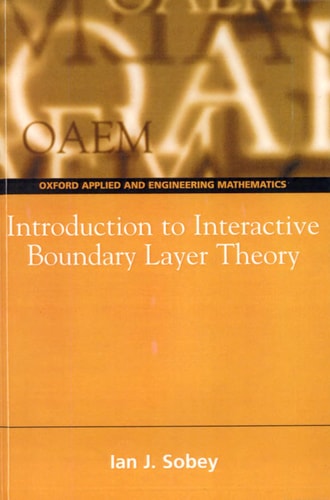
Introduction to Interactive Boundary Layer Theory
0
0
As an Amazon Associate and affiliate partner, Menrva Books earns from qualifying purchases. Learn more
Author Description
One of the major achievements in fluid mechanics in the last quarter of the twentieth century has been the development of an asymptotic description of perturbations to boundary layers known generally as 'triple deck theory'. These developments have had a major impact on our understanding of laminar fluid flow, particularly laminar separation. It is also true that the theory rests on three quarters of a century of development of boundary layer theory which involves analysis, experimentation and computation. All these parts go together, and to understand the triple deck it is necessary to understand which problems the triple deck resolves and which computational techniques have been applied. This book presents a unified account of the development of laminar boundary layer theory as a historical study together with a description of the application of the ideas of triple deck theory to flow past a plate, to separation from a cylinder and to flow in channels. The book is intended to provide a graduate level teaching resource as well as a mathematically oriented account for a general reader in applied mathematics, engineering, physics or scientific computation.
Menrva's Summary
THE THESIS
This text investigates the evolution and application of triple deck theory within the broader context of laminar boundary layer mechanics. I. J. Sobey provides a comprehensive synthesis of the historical development of boundary layer theory, bridging the gap between classical analysis and modern computational techniques. The work serves as both a pedagogical resource for graduate students and a rigorous reference for professionals in applied mathematics and engineering.
THE SCOPE MAP
What You Will Find
- Historical progression of boundary layer theory over the last century
- Mathematical derivation and application of triple deck theory
- Analysis of laminar separation in cylinders and channel flows
- Integration of analytical, experimental, and computational methodologies
THE AUTHORITY PERSPECTIVE
Experts recognize this volume as a specialized resource for those seeking a formal mathematical treatment of fluid separation phenomena. Readers frequently note the technical density of the prose, which assumes a strong background in advanced calculus and fluid dynamics.
Page Count:
352
Publication Date:
2001-02-15
Publisher:
Oxford University Press
ISBN-10:
0198506759
ISBN-13:
9780198506751
Physics
Mathematics
Engineering
Applied Mathematics
Community Tags
Similar Books