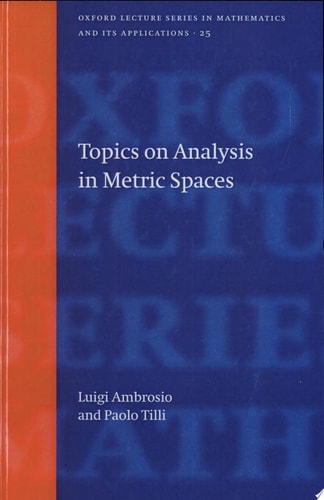
Topics on Analysis in Metric Spaces
0
0
As an Amazon Associate and affiliate partner, Menrva Books earns from qualifying purchases. Learn more
Author Description
This book presents the main mathematical prerequisites for analysis in metric spaces. It covers abstract measure theory, Hausdorff measures, Lipschitz functions, covering theorums, lower semicontinuity of the one-dimensional Hausdorff measure, Sobolev spaces of maps between metric spaces, and Gromov-Hausdorff theory, all developed ina general metric setting. The existence of geodesics (and more generally of minimal Steiner connections) is discussed on general metric spaces and as an application of the Gromov-Hausdorff theory, even in some cases when the ambient space is not locally compact. A brief and very general description of the theory of integration with respect to non-decreasing set functions is presented following the Di Giorgi method of using the 'cavalieri' formula as the definition of the integral. Based on lecture notes from Scuola Normale, this book presents the main mathematical prerequisites for analysis in metric spaces. Supplemented with exercises of varying difficulty it is ideal for a graduate-level short course for applied mathematicians and engineers.
Menrva's Summary
THE THESIS
This text investigates the foundational mathematical prerequisites and theoretical frameworks required to perform rigorous analysis within general metric spaces. Authors Luigi Ambrosio and Paolo Tilli, drawing from their lecture notes at the Scuola Normale, provide a structured approach to extending classical analytical concepts—such as measure theory and Sobolev spaces—into abstract metric settings. The book serves as a technical bridge for applied mathematicians and engineers, utilizing the Di Giorgi method and Gromov-Hausdorff theory to establish a consistent language for non-Euclidean geometric analysis.
THE SCOPE MAP
What You Will Find
- Comprehensive coverage of abstract measure theory and Hausdorff measures.
- Methodologies for analyzing Lipschitz functions and covering theorems.
- Theoretical frameworks for Sobolev spaces of maps between metric spaces.
- Applications of Gromov-Hausdorff theory regarding the existence of geodesics and minimal Steiner connections.
THE AUTHORITY PERSPECTIVE
Experts recognize this volume as a foundational resource for graduate-level study in geometric analysis. Readers frequently note the high level of technical density, which requires a strong background in real analysis to fully utilize the provided exercises and proofs.
Page Count:
144
Publication Date:
2004-02-26
Publisher:
Oxford University Press
ISBN-10:
0198529384
ISBN-13:
9780198529385
Mathematics
Analysis
Graduate Mathematics
Metric Spaces
Topology
Measure Theory
Community Tags
Similar Books