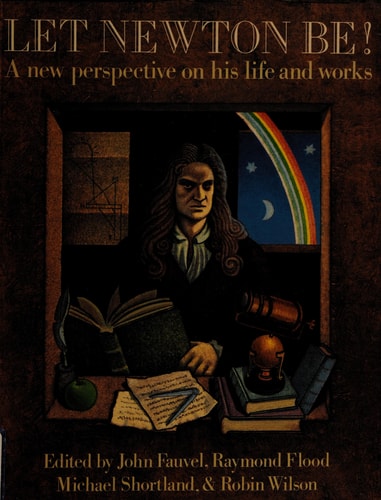
Let Newton Be!
0
0
As an Amazon Associate and affiliate partner, Menrva Books earns from qualifying purchases. Learn more
Author Description
In April, 1727, the French writer Voltaire viewed with astonishment the preparations for the funeral of Sir Isaac Newton. The late President of the Royal Society lay in state in Westminster Abbey for the week preceding the funeral on April 4th. On that day, his pall was borne in a ceremonious pageant by two dukes, three earls, and the Lord Chancellor. "He was buried," Voltaire wrote, "like a king who had done well by his subjects."Over the three hundred years since the publication of his Principia Mathematica, Newton has come to symbolize the ideal of scientist and mathematician par excellence. Let Newton Be! (the title comes from a famous couplet by Alexander Pope) explores the richness of Newton's life, labors, and legacy. What kind of scientist was Newton? What connections are there between the different strands of research he undertook? Why were his contemporaries so in awe of him? How has Newton's work left its mark on our understanding of the world? To address these questions, each chapter addresses a different aspect of Newton's life and work, making use of much new evidence about Newton uncovered in the last two decades. They consider Newton's work in mathematics and optics, his secret experiments with alchemy, his religious views (which were unconventional), the negative reaction to his work (as seen, for instance, in the poetry of William Blake), and his legacy for modern science. We learn that, were it not for Edmund Halley, Newton probably wouldn't have written his Principia at all; and that much of his work on planetary motion derived from his correspondence with Robert Hooke, a man Newton came to hate because he demanded credit for his contributions, which Newton refused to give.Richly illustrated, vividly written, and based on the latest scholarship, Let Newton Be! is an absorbing introduction to the legacy of Britain's greatest scientist as well as a fascinating study in the history of ideas.
Menrva's Summary
THE THESIS
This collection of essays investigates the multifaceted life and intellectual contributions of Sir Isaac Newton to determine how his work shaped the trajectory of modern science. The authors, a team of scholars including John Fauvel and Raymond Flood, utilize recent historical evidence to move beyond the myth of the solitary genius. They examine the interplay between Newton's scientific breakthroughs, his private alchemical pursuits, and his complex interpersonal relationships with contemporaries like Robert Hooke and Edmund Halley.
THE SCOPE MAP
What You Will Find
- Analysis of Newton's foundational work in mathematics and optics
- Examination of his unconventional religious views and secret alchemical experiments
- Historical context regarding his professional rivalries and collaborations
- Critical perspectives on his legacy, including reactions from figures like William Blake
THE AUTHORITY PERSPECTIVE
Experts and historians recognize this volume as a comprehensive and accessible synthesis of modern Newton scholarship. Readers frequently note that the text successfully balances academic rigor with a narrative style that remains engaging for non-specialists interested in the history of science.
Page Count:
280
Publication Date:
1989-02-23
Publisher:
Oxford University Press
ISBN-10:
019853924X
ISBN-13:
9780198539247
Non-Fiction
Biography
Science
History
Physics
Mathematics
Community Tags
Similar Books


Reader Comments
Share Your Thoughts
No comments yet. Be the first to share your thoughts!