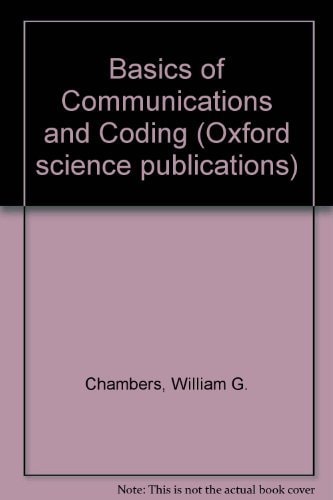
Basics of Communication and Coding
0
0
As an Amazon Associate and affiliate partner, Menrva Books earns from qualifying purchases. Learn more
Author Description
Intended to show how to attain reliable digital communications and coding, this book covers subjects such as Fourier theory, digital signaling methods, probability theory, and noisy channels. Moreover, it goes beyond standard treatments to cover emerging topics that will soon become commonplace in this rapidly changing field. Throughout, the topics selected are those in which the mathematics is both conceptually straightforward and useful in other contexts. Carefully worked out exercises at the end of each chapter illustrate the material presented and subsidiary themes. Advanced students and academics in communications in the field of electrical engineering will appreciate the unusually rigorous and realistic approach to the subject. Students and academics in physics, computer science, and mathematics concerned with communications will also find the book of interest.
Menrva's Summary
THE THESIS
This book investigates the fundamental principles required to achieve reliable digital communication and efficient coding in modern electronic systems. William N. Chambers provides a rigorous framework that bridges the gap between theoretical mathematics and practical engineering applications. By focusing on conceptually straightforward yet widely applicable mathematical models, the author equips students and academics with the tools necessary to navigate both established signaling methods and emerging technological trends.
THE SCOPE MAP
What You Will Find
- Comprehensive coverage of Fourier theory and its application to signal analysis.
- Detailed examination of digital signaling methods and probability theory in communication systems.
- Analysis of noisy channels and strategies for error correction and data integrity.
- Practical exercises at the end of each chapter designed to reinforce theoretical concepts and subsidiary themes.
THE AUTHORITY PERSPECTIVE
Experts and academics in the field of electrical engineering frequently highlight this text for its unusually rigorous and realistic approach to communication theory. The book is widely regarded as a valuable resource for students in physics, computer science, and mathematics who require a solid foundation in digital signaling.
Page Count:
240
Publication Date:
1985-07-18
Publisher:
Oxford University Press
ISBN-10:
0198531958
ISBN-13:
9780198531951
Computer Science
Electrical Engineering
Communications
Physics
Mathematics
Community Tags
Similar Books