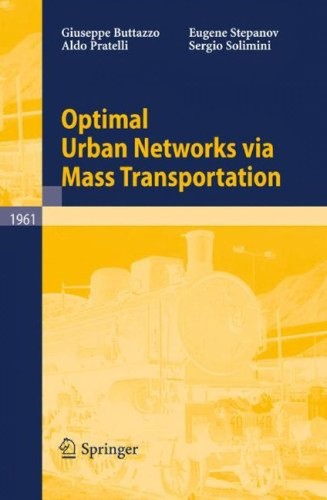
Optimal Urban Networks via Mass Transportation
0
0
As an Amazon Associate and affiliate partner, Menrva Books earns from qualifying purchases. Learn more
Author Description
Recently much attention has been devoted to the optimization of transportation networks in a given geographic area. One assumes the distributions of population and of services/workplaces (i.e. the network's sources and sinks) are known, as well as the costs of movement with/without the network, and the cost of constructing/maintaining it. Both the long-term optimization and the short-term, "who goes where" optimization are considered. These models can also be adapted for the optimization of other types of networks, such as telecommunications, pipeline or drainage networks. In the monograph we study the most general problem settings, namely, when neither the shape nor even the topology of the network to be constructed is known a priori.--Jacket.
Menrva's Summary
THE THESIS
This book investigates the optimization of urban transportation networks, focusing on mass transit systems. It addresses the complex problem of designing efficient networks when the distribution of population and services, movement costs, and construction/maintenance expenses are known, considering both long-term planning and short-term operational assignments. The monograph explores the most general problem settings, where the network's shape and topology are not predetermined.
THE SCOPE MAP
- Mathematical models for optimizing urban transportation networks.
- Analysis of population distribution and service/workplace locations as network sources and sinks.
- Consideration of movement costs (with and without the network) and construction/maintenance costs.
- Methods for both long-term network optimization and short-term assignment problems.
- Adaptability of models for other network types like telecommunications, pipelines, and drainage.
- Study of general problem settings where network shape and topology are unknown a priori.
THE AUTHORITY PERSPECTIVE
This monograph is likely to be regarded as a technical and rigorous treatment of urban network optimization, appealing to researchers and practitioners in transportation engineering and operations research. The detailed mathematical models and general problem settings suggest a dense, specialist text aimed at those with a strong background in optimization techniques. The focus on mass transportation and the adaptability of models to other network types indicate a broad applicability within scientific and engineering disciplines.
Page Count:
150
Publication Date:
2008-01-01
ISBN-10:
3540857982
ISBN-13:
9783540857983
Science
Non-Fiction
Operations Research
Transportation Engineering
urban planning
Community Tags
Similar Books