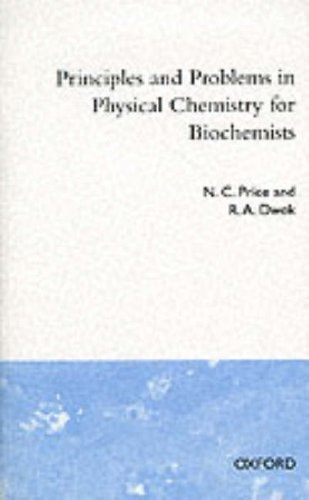
Principles and Problems in Physical Chemistry for Biochemists
0
0
As an Amazon Associate and affiliate partner, Menrva Books earns from qualifying purchases. Learn more
Author Description
What use is physical chemistry to the student of biochemistry and biology? This central question is answered in this book mainly through the use of worked examples and problems. The text is brief and concise. It starts by introducing the laws of thermodynamics, and then uses these laws to derive the equations relevant to the student in dealing with chemical equilibria (including the binding of small molecules to proteins), properties of solutions, acids and bases, and oxidation-reduction processes. The student is thus shown how a knowledge of thermodynamic qualities makes it possible to predict whether, and how, a reaction will proceed. Thermodynamics, however, gives no information about how fast a reaction will happen. The study of the rates at which processes occur (kinetics) forms the second main theme of the book. This section poses and answers questions such as `how is the rate of a reaction affected by temperature, pH, ionic strength, and the nature of the reactants? These same ideas are then shown to be useful in the study of enzyme-catalysed reactions. Sections new to the second edition deal with co-operative binding of ligands, ultracentrifugation, oxidative phosphorylation, and two-substrate enzyme kinetics, and have been designed to cater for the requirements of a wide variety of biochemistry courses. This reprint of the second edition includes a thermodynamically more rigorous account of acid/base chemistry. The text should continue to appeal to all students interested in biology and biochemistry.
Menrva's Summary
THE THESIS
This book investigates the practical application of physical chemistry principles to the study of biological systems. Authors Nicholas C. Price and Raymond A. Dwek utilize a problem-based learning approach to bridge the gap between abstract thermodynamic laws and the specific biochemical processes relevant to students. By focusing on worked examples, the text provides a quantitative framework for understanding chemical equilibria, reaction rates, and enzyme kinetics within a biological context.
THE SCOPE MAP
What You Will Find
- Comprehensive coverage of thermodynamic laws applied to chemical equilibria and protein-ligand binding.
- Detailed analysis of reaction kinetics, including the influence of temperature, pH, and ionic strength.
- Methodological explanations of enzyme-catalyzed reactions and two-substrate kinetics.
- Technical discussions on advanced topics such as ultracentrifugation and oxidative phosphorylation.
THE AUTHORITY PERSPECTIVE
Experts and educators recognize this text as a foundational resource for students seeking to apply physical chemistry to biological research. Readers frequently note the concise nature of the prose and the utility of the worked examples in mastering complex biochemical calculations.
Page Count:
272
Publication Date:
1980-01-10
Publisher:
Oxford University Press
ISBN-10:
0198555121
ISBN-13:
9780198555124
Science
textbook
Thermodynamics
Chemistry
Biochemistry
Chemistry Physical
Kinetics
Community Tags
Similar Books