Statistical Thermodynamics
0
0
As an Amazon Associate and affiliate partner, Menrva Books earns from qualifying purchases. Learn more
Author Description
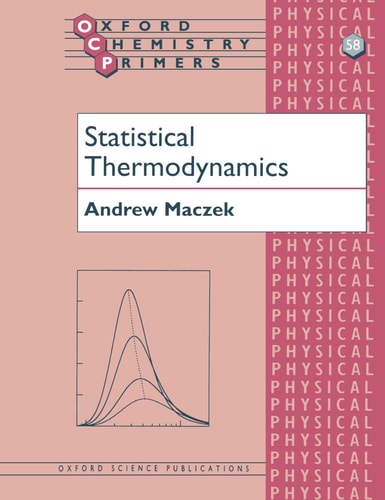
Statistical Thermodynamics sets out to provide the basic groundwork that will lead 3rd and 4th year undergraduate students of chemistry and chemical engineering from their existing knowledge of elementary classical thermodynamics to an understanding of the predictable statistical behaviour of assemblies of large numbers of identical molecules, in an ideal gas at constant temperature and volume. It begins by establishing the basis of the Boltzmann distribution law and proceeds, through definition of the molecular partition function, to link the laws of thermodynamics (which avoid any mention of atomic or quantum theory) to the statistical behaviour of assemblies of quantum particles. Equations are derived that relate thermodynamic state functions to the molecular partition function and these form a basic tool kit with which to tackle problems from a knowledge only of the relative populations of quantum energy states. The various contributions to the partition function (translation, rotation, vibration, electronic) are explored and derived. The book ends with a chapter in which all the concepts are brought together in the calculation of equilibrium constants for reactions between ideal gases. A number of fully worked examples are included, making this an invaluable aid to undergraduate chemistry, physics, chemical engineering and materials science courses. Postgraduate biochemists and molecular biologists will also find this book useful.
Menrva's Summary
THE THESIS
This text investigates the bridge between classical thermodynamics and the statistical behavior of molecular assemblies through the application of quantum theory. Andrew Maczek, drawing on his academic background in chemistry, provides a structured framework that guides students from elementary thermodynamic principles to the derivation of molecular partition functions. By focusing on the Boltzmann distribution law, the book establishes a quantitative toolkit for calculating thermodynamic state functions based on quantum energy state populations.
THE SCOPE MAP
What You Will Find
- Derivation of molecular partition functions including translational, rotational, vibrational, and electronic contributions.
- Application of the Boltzmann distribution law to ideal gas assemblies.
- Calculation methods for equilibrium constants in gas-phase reactions.
- Pedagogical tools including fully worked examples for undergraduate and postgraduate study.
THE AUTHORITY PERSPECTIVE
Experts and educators identify this text as a foundational resource for bridging the gap between classical and statistical thermodynamics in undergraduate curricula. Readers frequently note the clarity of the mathematical derivations and the utility of the worked examples for students in chemistry and chemical engineering.
Page Count:
96
Publication Date:
1998-06-11
Publisher:
Oxford University Press
ISBN-10:
0198559119
ISBN-13:
9780198559115
Science
Statistical thermodynamics
textbook
Chemical Engineering
Physics
Chemistry
Chemistry Physical
Thermodynamics
Community Tags
Similar Books