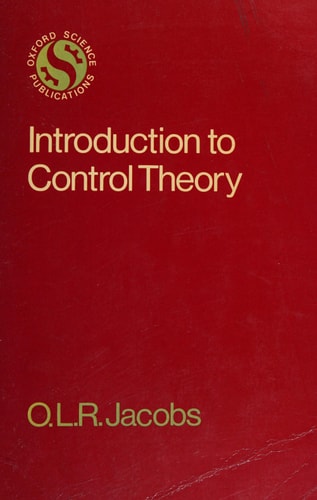
Introduction to Control Theory
0
0
As an Amazon Associate and affiliate partner, Menrva Books earns from qualifying purchases. Learn more
Author Description
This textbook provides an introduction to feedback control systems. It unifies relevant topics in a single volume. The mathematical level is that of final-year undergraduate courses in engineering, but there is minimal emphasis on technical mathematics. It provides insights to guide the design of practical systems. It should be suitable for anyone whose mathematical background includes the classical solution of ordinary differential or difference equations, the elements of probability theory and matrix algebra, as well as some confidence in manipulating mathematical expressions. A structural framework for the book is provided by three topics from applied mathematics that are regarded as providing the classical high ground of control scalar, ordinary, linear dynamic equations with constant co-efficients; state space and optimal control theory in the form of dynamic programming - this being the optimization technique which offers greatest generality; and elementary probability theory, and in particular, Bayes' rule. Much of this edition has been rewritten to take account of recent developments in control theory and in how it is understood. In particular, the recognition that feedback control systems are essentially information-processing systems leads to the insight that every feedback controller must perform an information-processing function of state-estimation, that the design of a controller requires some prior information, and that the quality of achievable control depends on the quality of available information and on the manner in which it is used, as well as on characteristics of the controlled object. Features of the first edition that have been retained include the uniform treatment of both continuous-time and discrete-time systems, the provision of problems with answers and the inclusion of a wide range of topics.
Menrva's Summary
THE THESIS
This textbook investigates the fundamental principles of feedback control systems by unifying diverse mathematical concepts into a coherent framework for practical engineering design. Author O. L. R. Jacobs presents a structured approach that emphasizes the information-processing nature of control systems, arguing that effective design relies on state estimation and the quality of available data. The text is designed for final-year undergraduate engineering students, balancing theoretical depth with a focus on application rather than purely abstract mathematics.
THE SCOPE MAP
What You Will Find
- Analysis of linear dynamic equations with constant coefficients.
- Application of state space and optimal control theory through dynamic programming.
- Integration of probability theory and Bayes' rule in control contexts.
- Comparative study of continuous-time and discrete-time system methodologies.
THE AUTHORITY PERSPECTIVE
Experts recognize this work as a foundational text that successfully bridges the gap between classical control theory and modern information-processing perspectives. Readers frequently note the clarity of the author's approach, which makes complex optimization techniques accessible to students with a standard undergraduate mathematical background.
Page Count:
384
Publication Date:
1982-01-01
Publisher:
Oxford University Press
ISBN-10:
0198561482
ISBN-13:
9780198561484
Mathematics
Control Theory
Engineering
textbook
Applied Science
Community Tags
Similar Books