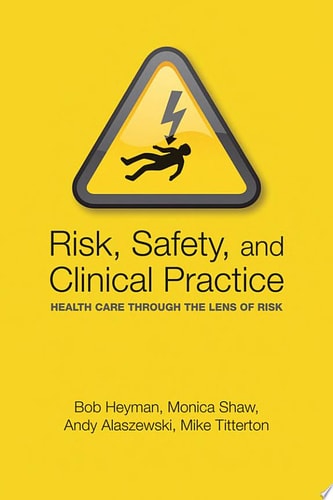
Risk, Safety and Clinical Practice: Healthcare through the lens of risk
0
0
As an Amazon Associate and affiliate partner, Menrva Books earns from qualifying purchases. Learn more
Author Description
Risk thinking is transforming the understanding, organization, and management of heatlth care systems, and its significance is likely to increase still further over the next two decades as technological advances, for example the new genetics and the discovery of new biomedical markers, open up novel possibilities for health risk management.Heightened societal risk consciousness, such as food panics and the debate over the MMR vaccine, co-exists, apparently paradoxically, with increased life expectancy in advanced industrial societies and increasing concern about the longer term future. At the same time, social trends are pushing health care systems towards the surveillance of populations and the targeting of groups identified as being at higher risk. All too often, services users, health professionals, policy makers, and researchers draw upon a risk management without reflecting critically on its assumptions or limitations.This introductory text focuses on the underlying generic issues of risk management in health care. Aimed at health professionals, managers, educators and policy makers who are concerned with risk management, it allows the readers to analyze risk management issues, and to critically evaluate the claims made about exisiting and new technologies, in an informed way. It covers all aspects of risk relevant to a clinical setting and is closely related to decision making in the clinic.
Menrva's Summary
THE THESIS
This text investigates how the pervasive framework of risk management shapes the organization, delivery, and ethical landscape of modern healthcare systems. The authors, a multidisciplinary team of experts in health policy and sociology, argue that while risk assessment is vital for clinical decision-making, it is frequently applied without sufficient critical reflection on its underlying assumptions. By examining the intersection of technological advancement, societal anxiety, and institutional surveillance, the book provides a structured methodology for professionals to evaluate the validity and limitations of risk-based interventions.
THE SCOPE MAP
What You Will Find
- Analysis of the impact of new genetics and biomedical markers on clinical risk management.
- Examination of the paradox between increased life expectancy and heightened societal risk consciousness.
- Methodologies for critically evaluating the claims of emerging health technologies.
- Frameworks for understanding the shift toward population surveillance and targeted risk identification.
THE AUTHORITY PERSPECTIVE
Experts identify this work as a foundational text for clinicians and policy makers seeking to navigate the complexities of modern risk management. Readers frequently note the academic rigor of the prose, which effectively bridges the gap between sociological theory and practical clinical application.
Page Count:
248
Publication Date:
2010-02-01
Publisher:
Oxford University Press
ISBN-10:
0198569009
ISBN-13:
9780198569008
Sociology
Hospitals
Healthcare
Medical policy
Public Health
Medical care
Community Tags
Similar Books