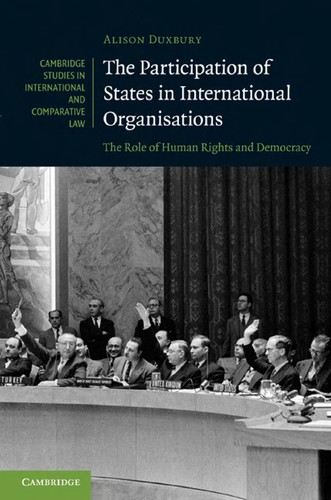
The Participation of States in International Organisations
0
0
As an Amazon Associate and affiliate partner, Menrva Books earns from qualifying purchases. Learn more
Author Description
The admission of a state to membership is an important decision for an international organisation. In making this determination, organisations are increasingly promoting the observance of human rights and democratic governance as relevant principles. They have also applied the same criteria in resolving the question of whether existing members should be excluded from an organisation's processes. Through a systematic examination of the records, proceedings and practice of international organisations, Alison Duxbury examines the role and legitimacy of human rights and democracy as membership criteria. A diverse range of examples is discussed, including the membership policies and practice of the League of Nations and the United Nations; the admission of the Central and Eastern European states to the European Union; developments in regional organisations in Africa, Asia and the Americas; and the exclusion of members from the UN specialised agencies
Menrva's Summary
THE THESIS
This book investigates the evolving role and legitimacy of human rights and democratic governance as criteria for state membership and exclusion in international organizations. The author, Alison Duxbury, systematically examines the records, proceedings, and practices of various international bodies to understand how these principles are applied. The study covers historical examples like the League of Nations and the United Nations, contemporary cases such as the European Union's admission of Central and Eastern European states, and regional developments across Africa, Asia, and the Americas. It also addresses the complex issue of excluding existing members or their representatives from organizational processes.
THE SCOPE MAP
- Analysis of membership policies and practices of the League of Nations and the United Nations.
- Examination of the admission of Central and Eastern European states to the European Union.
- Discussion of developments in regional organizations in Africa, Asia, and the Americas.
- Case studies on the exclusion of members from UN specialized agencies.
- Exploration of the Commonwealth and Organization of American States' approaches to membership and exclusion.
- Review of decisions to deny accreditation to delegations in the UN General Assembly.
- Assessment of the increasing promotion of human rights and democratic governance as admission principles.
THE AUTHORITY PERSPECTIVE
The book provides a systematic examination of how international organizations are increasingly using human rights and democratic governance as criteria for state membership and exclusion. It draws on a diverse range of examples, from historical bodies like the League of Nations to contemporary regional organizations. The author's detailed analysis of records, proceedings, and practice offers a thorough perspective on the legitimacy and application of these principles. The work is positioned as a key resource for understanding the evolving standards within international law and relations.
Page Count:
382
Publication Date:
2011-01-01
ISBN-10:
0521192005
ISBN-13:
9780521192002
History
Non-Fiction
Politics
Human rights
International Law
International relations
Democracy
Community Tags
Similar Books