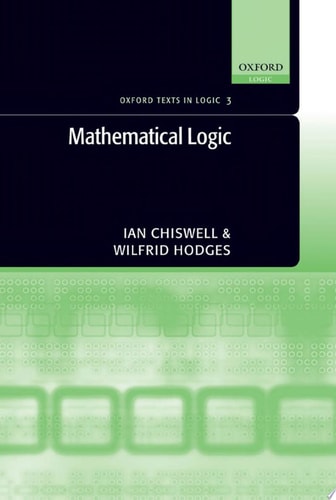
Mathematical Logic
0
0
As an Amazon Associate and affiliate partner, Menrva Books earns from qualifying purchases. Learn more
Author Description
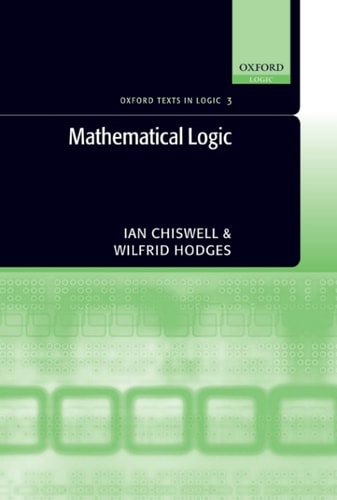
Assuming no previous study in logic, this informal yet rigorous text covers the material of a standard undergraduate first course in mathematical logic, using natural deduction and leading up to the completeness theorem for first-order logic. At each stage of the text, the reader is given an intuition based on standard mathematical practice, which is subsequently developed with clean formal mathematics. Alongside the practical examples, readers learn what can and can't be calculated; for example the correctness of a derivation proving a given sequent can be tested mechanically, but there is no general mechanical test for the existence of a derivation proving the given sequent. The undecidability results are proved rigorously in an optional final chapter, assuming Matiyasevich's theorem characterising the computably enumerable relations. Rigorous proofs of the adequacy and completeness proofs of the relevant logics are provided, with careful attention to the languages involved. Optinal sections discuss the classification of mathematical structures by first-order theories; the required theory of cardinality is developed from scratch. Throughout the book there are notes on historical aspects of the material, and connections with linguistics and computer science, and the discussion of syntax and semantics is influenced by modern linguistic approaches. Two basic themes in recent cognitive science studies of actual human reasoning are also introduced. Including extensive exercises and selected solutions, this text is ideal for students in logic, mathematics, philosophy, and computer science.
Menrva's Summary
THE THESIS
This text investigates the foundational principles of mathematical logic, providing a rigorous yet accessible introduction to first-order logic for undergraduate students. Authors Ian Chiswell and Wilfrid Hodges draw upon their extensive academic backgrounds to bridge the gap between intuitive mathematical practice and formal symbolic systems. By utilizing natural deduction and incorporating modern linguistic and cognitive science perspectives, the authors establish a framework that prepares students for advanced study in logic, computation, and philosophy.
THE SCOPE MAP
What You Will Find
- Comprehensive coverage of natural deduction and the completeness theorem for first-order logic.
- Rigorous proofs regarding the undecidability of logical systems and computably enumerable relations.
- Integrated historical notes and interdisciplinary connections to linguistics and computer science.
- Extensive problem sets with selected solutions to reinforce formal mathematical techniques.
THE AUTHORITY PERSPECTIVE
Experts and educators frequently cite this work as a foundational text for its ability to balance formal rigor with clear, intuitive explanations. Readers often note the text's effectiveness in guiding students through complex proofs while maintaining a connection to broader applications in cognitive science and computation.
Page Count:
296
Publication Date:
2007-07-12
Publisher:
Oxford University Press
ISBN-10:
0198571003
ISBN-13:
9780198571001
Philosophy
textbook
Logic
Computer Science
Mathematics