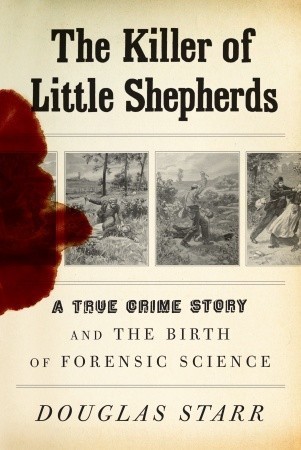
The Killer of Little Shepherds
0
0
As an Amazon Associate and affiliate partner, Menrva Books earns from qualifying purchases. Learn more
Author Description
This book is a riveting true crime story that vividly recounts the birth of modern forensics. At the end of the 19th century, serial murderer Joseph Vacher, known and feared as "The Killer of Little Shepherds," terrorized the French countryside. He eluded authorities for years until he ran up against prosecutor Emile Fourquet and Dr. Alexandre Lacassagne, the era's most renowned criminologist. The two men, intelligent and bold, typified the Belle Époque, a period of immense scientific achievement and fascination with science's promise to reveal the secrets of the human condition. With high drama and stunning detail, Douglas Starr revisits Vacher's infamous crime wave, interweaving the story of how Lacassagne and his colleagues were developing forensic science as we know it. We see one of the earliest uses of criminal profiling, as Fourquet painstakingly collects eyewitness accounts and constructs a map of Vacher's crimes. We follow the tense and exciting events leading to the murderer's arrets. And we witness the twists and turns of the trial, celebrated in its day. In an attempt to disprove Vacher's defense by reason of insanity, Fourquet recruits Lacassagne, who in the previous decades had revolutionized criminal science by refining the use of blood-spatter evidence, systematizing the autopsy, and doing groundbreaking research in psychology. Lacassagne's efforts lead to a gripping courtroom denouement. The Killer of Little Shepherds is an important contribution to the history of criminal justice, impressively researched and thrillingly told. - Jacket flap.
Menrva's Summary
THE THESIS
The birth of modern forensics is vividly recounted through the pursuit of a notorious serial killer. In the late 19th century, Joseph Vacher, known as "The Killer of Little Shepherds," terrorized the French countryside, evading capture for years. His pursuit brought together prosecutor Emile Fourquet and Dr. Alexandre Lacassagne, a leading criminologist of the Belle Époque. This period was marked by significant scientific advancement and a belief in science's ability to unlock human secrets. The narrative details Vacher's crime spree and the parallel development of forensic science by Lacassagne and his peers.
THE SCOPE MAP
- The crime wave and pursuit of serial murderer Joseph Vacher in late 19th-century France.
- The development and application of early forensic science techniques by Dr. Alexandre Lacassagne.
- The use of criminal profiling and eyewitness accounts by prosecutor Emile Fourquet.
- The tense events leading to Vacher's arrest and the subsequent trial.
- Lacassagne's contributions to psychology, blood-spatter analysis, and autopsy refinement.
- A gripping courtroom climax driven by forensic evidence.
THE AUTHORITY PERSPECTIVE
This book is regarded as an important contribution to the history of criminal justice, impressively researched and thrillingly told. The narrative interweaves the story of a notorious serial killer with the foundational development of forensic science. It highlights the intellectual rigor and scientific innovation of the Belle Époque, showcasing how early forensic techniques were applied in a high-profile case. The book offers a detailed account of the investigation, trial, and the scientific methods that led to a dramatic courtroom conclusion.
Page Count:
0
Publication Date:
2010-01-01
ISBN-10:
0307266192
ISBN-13:
9780307266194
Biography
Non-Fiction
Science
History
True Crime
Forensic Science
Community Tags
Similar Books