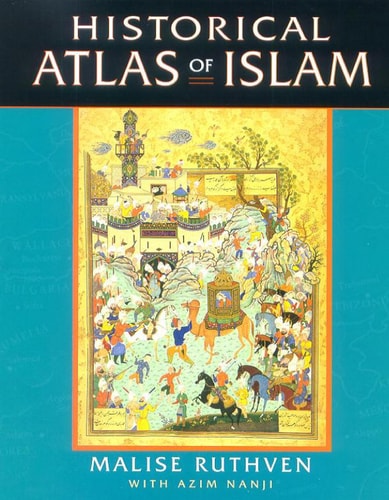
Historical Atlas of the Islamic World
0
0
As an Amazon Associate and affiliate partner, Menrva Books earns from qualifying purchases. Learn more
Author Description
There is without question immense general and academic interest in the Islamic world at present. After the attacks on New York and Washington in September 2001 and the wars on Afghanistan and Iraq, 'Islamic Fundamentalism' has come to be seen by many people in the West as the primary threat to world peace. Although not all scholars would agree that we are heading for a 'Clash on Civilizations' between Islam and the West, few would dispute that Islamic and Western cultures have evolved very differently. It is impossible to have a real understanding of current Islam without first understanding the historical perspective. Malise Ruthven, author of many acclaimed works on Islam and the Islamic world, including Fundamentalism, A Fury of God: The Islamist Attack on America, and Islam: A Very Short Introduction, and a regular commentator in the print and broadcast media, is ideally placed to provide this perspective. Thoroughly researched and very well written, the Historical Atlas of the Islamic World is concise, accessible, and authoritative. It spans the period from pre-Islamic late antiquity to the present day, incorporating recent patterns of emigration from Muslim-majority countries and the independence of the post-Soviet Muslim states of Central Asia. The maps use the latest design techniques to indicate the shifting nature of frontiers and population densities. In addition to historical maps of the changing internal and external boundaries of the Islamic World, there are maps showing the principle trade routes through which ideas and customs as well as goods were spread. Other maps and charts trace the rise and fall of Islamic dynasties and religious sects, the structure of cities, the distribution of minerals and water resources, agricultural patterns, and archaeological sites. The maps are accompanied by short essays on a wide range of themes, among them: all the countries and regions with Muslim majorities; institutions such as Shari'a (divine law) and fiqh.
Menrva's Summary
THE THESIS
This work investigates the historical evolution, geographical expansion, and cultural development of the Islamic world from late antiquity to the modern era. Authors Azim Nanji and Malise Ruthven utilize a multidisciplinary approach, combining cartographic data with concise historical essays to contextualize the complexities of Islamic societies. By mapping the shifting frontiers, trade routes, and demographic changes, the authors provide a framework for understanding the contemporary geopolitical landscape of Muslim-majority regions.
THE SCOPE MAP
What You Will Find
- Historical maps detailing the rise and fall of Islamic dynasties and religious sects.
- Geographic analysis of trade routes, resource distribution, and urban structures.
- Essays covering institutional frameworks such as Shari'a and fiqh.
- Comprehensive coverage of post-Soviet Muslim states and modern migration patterns.
THE AUTHORITY PERSPECTIVE
Experts and scholars recognize this atlas as a foundational resource for students and general readers seeking to contextualize current events within a long-term historical framework. Readers frequently note the clarity of the cartographic design and the accessibility of the accompanying analytical essays.
Page Count:
208
Publication Date:
2004-09-01
Publisher:
Oxford Univ Pr
ISBN-10:
0198609973
ISBN-13:
9780198609971
History
Atlases
Reference
New Used & Rental Textbooks
Geography
Islamic Studies
Community Tags
Similar Books