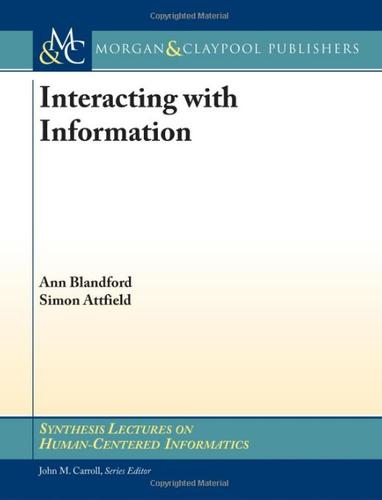
Interacting with Information
0
0
As an Amazon Associate and affiliate partner, Menrva Books earns from qualifying purchases. Learn more
Author Description
We live in an "information age," but information is only useful when it is interpreted by people and applied in the context of their goals and activities. The volume of information to which people have access is growing at an incredible rate, vastly outstripping people's ability to assimilate and manage it. In order to design technologies that better support information work, it is necessary to better understand the details of that work. In this lecture, we review the situations (physical, social and temporal) in which people interact with information. We also discuss how people interact with information in terms of an "information journey," in which people, iteratively, do the following: recognise a need for information, find information, interpret and evaluate that information in the context of their goals, and use the interpretation to support their broader activities. People's information needs may be explicit and clearly articulated but, conversely, may be tacit, exploratory and evolving. Widely used tools supporting information access, such as searching on the Web and in digital libraries, support clearly defined information requirements well, but they provide limited support for other information needs. Most other stages of the information journey are poorly supported at present. Novel design solutions are unlikely to be purely digital, but to exploit the rich variety of information resources, digital, physical and social, that are available. Theories of information interaction and sensemaking can highlight new design possibilities that augment human capabilities. We review relevant theories and findings for understanding information behaviours, and we review methods for evaluating information working tools, to both assess existing tools and identify requirements for the future. - Publisher.
Menrva's Summary
THE THESIS
This lecture explores the complexities of human interaction with information in the digital age. Ann Blandford, a recognized expert in information science, reviews the multifaceted situations—physical, social, and temporal—in which individuals engage with information. The discussion frames this engagement as an
THE SCOPE MAP
- Analysis of the physical, social, and temporal contexts of information interaction.
- The concept of the "information journey" including need recognition, finding, interpreting, evaluating, and using information.
- Discussion of how current tools like web search and digital libraries support specific needs but fall short in others.
- Exploration of novel design solutions that integrate digital, physical, and social information resources.
- Review of theories in information interaction and sensemaking to augment human capabilities.
- Examination of methods for evaluating information working tools and identifying future requirements.
THE AUTHORITY PERSPECTIVE
This work is positioned as a foundational review for understanding information behavior and designing supportive technologies. It addresses the growing challenge of information overload by dissecting the 'information journey' and highlighting the limitations of current digital tools. The lecture suggests that future designs must be more holistic, integrating diverse resources and theoretical insights to better augment human capabilities in managing and utilizing information.
Page Count:
85
Publication Date:
2010-01-01
ISBN-10:
1608450260
ISBN-13:
9781608450268
Action
Non-Fiction
Science
Information behavior
Information Science
Community Tags
Similar Books