Hall of Mirrors
0
0
As an Amazon Associate and affiliate partner, Menrva Books earns from qualifying purchases. Learn more
Author Description
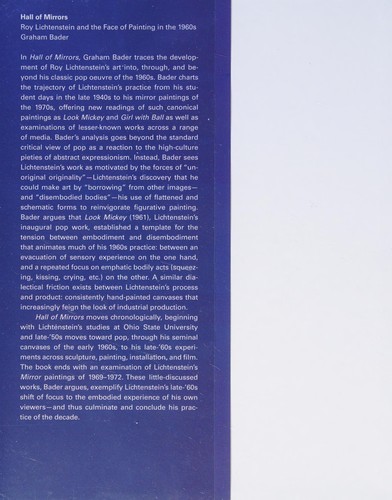
In Hall of Mirrors, Graham Bader traces the development of Roy Lichtenstein's art into, through, and beyond his classic pop oeuvre of the 1960s. Bader charts the trajectory of Lichtenstein's practice from his student days in the late 1940s to his mirror paintings of the 1970s, offering new readings of such canonical paintings as Look Mickey and Girl with Ball as well as examinations of lesser-known works across a range of media. Bader's analysis goes beyond the standard critical view of pop as a reaction to the high-culture pieties of abstract expressionism. Instead, Bader sees Lichtenstein's work as motivated by the forces of "unoriginal originality"--Lichtenstein's discovery that he could make art by "borrowing" from other images - and "disembodied bodies"--his use of flattened and schematic forms to reinvigorate figurative painting. Bader argues that 1961's Look Mickey, Lichtenstein's inaugural pop work, established a template for the tension between embodiment and disembodiment that animates much of his 1960s practice: between an evacuation of sensory experience, on the one hand, and a repeated focus on emphatic bodily acts (squeezing, kissing, crying, etc.) on the other. A similar dialectical friction exists between Lichtenstein's process and product: consistently hand-painted canvases that increasingly feign the look of industrial production. Hall of Mirrors moves chronologically, beginning with Lichtenstein's studies at Ohio State University and late-'50s moves toward pop, through his seminal canvases of the early 1960s, to his late-'60s experiments across sculpture, painting, installation, and film. The book ends with an examination of Lichtenstein's Mirror paintings of 1969-72. These little-discussed works, Bader argues, exemplify Lichtenstein's late-'60s shift of focus to the embodied experience of his own viewers - and thus culminate and conclude his practice of the decade.
Menrva's Summary
THE THESIS
The book investigates the evolution of Roy Lichtenstein's artistic practice from his early student days through his iconic 1960s pop period and into his later mirror paintings. Graham Bader, an art historian, analyzes Lichtenstein's work by focusing on concepts of "unoriginal originality" and "disembodied bodies." The analysis moves chronologically, examining canonical and lesser-known works across various media, including painting, sculpture, installation, and film. Bader challenges the view of pop art solely as a reaction to Abstract Expressionism, instead highlighting Lichtenstein's unique approach to image appropriation and figurative representation.
THE SCOPE MAP
- Chronological survey of Roy Lichtenstein's career from the 1940s to the early 1970s.
- In-depth analysis of key works such as 'Look Mickey' and 'Girl with Ball'.
- Exploration of Lichtenstein's theoretical concepts: "unoriginal originality" and "disembodied bodies."
- Examination of lesser-known works across painting, sculpture, installation, and film.
- New readings of pop art that move beyond its relationship with Abstract Expressionism.
- Focus on the tension between embodiment and disembodiment in Lichtenstein's figures.
- Analysis of the dialectical friction between Lichtenstein's process and product, particularly the feigned industrial look of his hand-painted canvases.
- Concluding examination of Lichtenstein's Mirror paintings (1969-72) and their focus on viewer experience.
THE AUTHORITY PERSPECTIVE
This book is regarded as a significant contribution to the scholarship on Roy Lichtenstein, offering a detailed chronological examination of his artistic development. Bader's analysis of "unoriginal originality" and "disembodied bodies" provides fresh perspectives on Lichtenstein's oeuvre, moving beyond conventional interpretations of Pop Art. The book is noted for its comprehensive scope, covering works across multiple media and periods, including less-discussed pieces. It is recognized for its rigorous art historical methodology and its nuanced engagement with the complexities of Lichtenstein's practice.
Page Count:
258
Publication Date:
2010-01-01
ISBN-10:
0262026473
ISBN-13:
9780262026475
Art
Non-Fiction
Pop Art
Art History
Community Tags
Similar Books