A Free Will
0
0
As an Amazon Associate and affiliate partner, Menrva Books earns from qualifying purchases. Learn more
Author Description
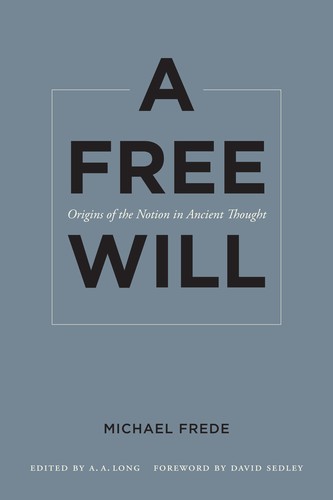
Where does the notion of free will come from? How and when did it develop, and what did that development involve? In Michael Frede's radically new account of the history of this idea, the notion of a free will emerged from powerful assumptions about the relation between divine providence, correctness of individual choice, and self-enslavement due to incorrect choice. Anchoring his discussion in Stoicism, Frede begins with Aristotle--who, he argues, had no notion of a free will--and ends with Augustine. Frede shows that Augustine, far from originating the idea (as is often claimed), derived most of his thinking about it from the Stoicism developed by Epictetus. - Publisher.
Menrva's Summary
THE THESIS
The development of the concept of free will is traced from its ancient roots to its early Christian formulation. Michael Frede's work challenges conventional understandings by arguing that the notion of free will did not originate with Augustine, as is often assumed. Instead, Frede posits that the idea emerged from complex Stoic assumptions concerning divine providence, the correctness of individual choices, and the consequences of self-enslavement through incorrect decisions. The book meticulously analyzes the philosophical landscape from Aristotle, who Frede contends lacked a concept of free will, through to Augustine, demonstrating how Augustine's thought on the matter was significantly influenced by Stoic thinkers like Epictetus.
THE SCOPE MAP
- Exploration of the origins and development of the concept of free will.
- Analysis of philosophical assumptions linking divine providence, choice correctness, and self-enslavement.
- Detailed examination of Stoic philosophy, particularly the ideas of Epictetus.
- Re-evaluation of Aristotle's stance on free will, arguing for its absence in his philosophy.
- Tracing the intellectual lineage of Augustine's ideas on free will back to Stoicism.
- Discussion of the relationship between individual choice and its consequences within ancient and early Christian thought.
THE AUTHORITY PERSPECTIVE
This scholarly work is recognized for its rigorous historical analysis and its challenge to established narratives regarding the origins of the concept of free will. Frede's argument, which anchors the development of free will in Stoic thought and reinterprets Augustine's contributions, is presented with detailed textual evidence. The book is likely to be of significant interest to specialists in ancient philosophy, the history of ideas, and theological studies. Its detailed engagement with primary sources and its revisionist thesis position it as a key text for understanding the philosophical evolution of this fundamental concept.
Page Count:
0
Publication Date:
2011-01-01
ISBN-10:
0520268482
ISBN-13:
9780520268487
History
Non-Fiction
Philosophy
Christian philosophy
Community Tags
Similar Books