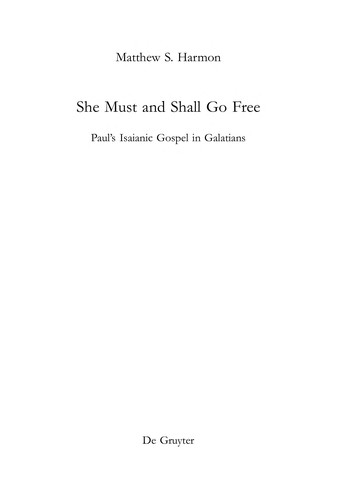
She Must and Shall Go Free
0
0
As an Amazon Associate and affiliate partner, Menrva Books earns from qualifying purchases. Learn more
Author Description
Scholars have long recognized the importance of Paul’s citations from the Pentateuch for understanding the argument of Galatians. But what has not been fully appreciated is the key role that Isaiah plays in shaping what Paul says and how he says it, even though he cites Isaiah explicitly only once (Isaiah 54:1 in Galatians 4:27). Using an intertextual approach to trace more subtle appropriations of Scripture (i.e., allusions, echoes and thematic parallels), Harmon argues that Isaiah 49-54 in particular has shaped the structure of Paul’s argument and the content of his theological reflection in Galatians. Each example of Isaianic influence is situated within its original context as well as its new context in Galatians. Attention is also paid to how those same Isaianic texts were interpreted in Second Temple Judaism, providing the larger interpretive context within which Paul read Scripture. The result is fresh light shed on Paul’s self-understanding as an apostle to the Gentiles, the content of his gospel message, his reading of the Abraham story and the larger structure of Galatians.
Menrva's Summary
THE THESIS
This book investigates the significant, yet often overlooked, influence of the Book of Isaiah on the Apostle Paul's Epistle to the Galatians. While Paul's explicit citations of Isaiah are few, Harmon employs an intertextual approach to demonstrate how Isaiah 49-54, in particular, profoundly shapes the structure and theological content of Galatians. The study examines how Paul's use of Isaiah is situated within its original context, its new context in Galatians, and the broader interpretive landscape of Second Temple Judaism, offering new insights into Paul's self-understanding and his gospel message.
THE SCOPE MAP
- Analysis of subtle appropriations of Scripture (allusions, echoes, thematic parallels) from Isaiah in Galatians.
- Detailed examination of Isaiah 49-54's influence on the structure and theological reflection in Galatians.
- Contextualization of Isaianic texts within their original setting and their application in Galatians.
- Exploration of Second Temple Jewish interpretations of Isaiah to understand Paul's hermeneutical framework.
- Fresh perspectives on Paul's identity as an apostle to the Gentiles.
- New light shed on the content of Paul's gospel message.
- Re-evaluation of Paul's interpretation of the Abraham story within Galatians.
THE AUTHORITY PERSPECTIVE
This scholarly work is positioned as a significant contribution to Pauline and Isaianic studies, likely appealing to academics and advanced students of biblical exegesis. The detailed intertextual analysis promises to offer novel interpretations of a key New Testament epistle. The book's focus on subtle scriptural appropriations suggests a rigorous, evidence-based argument that will be of interest to those studying early Christian hermeneutics and the relationship between the Old and New Testaments. The thorough contextualization within both Jewish and Christian interpretive traditions aims to provide a comprehensive understanding of Paul's theological project in Galatians.
Page Count:
330
Publication Date:
2010-01-01
ISBN-10:
3110221756
ISBN-13:
9783110221756
Non-Fiction
Religion
Hermeneutics
New Testament
Old Testament
Theology
Community Tags
Similar Books