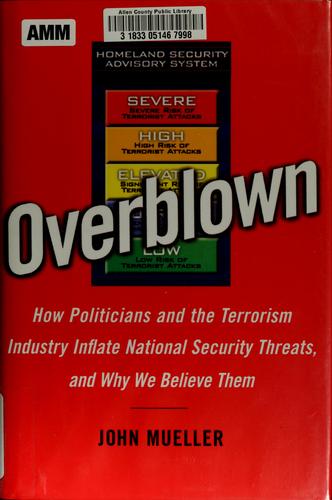
Overblown
0
0
As an Amazon Associate and affiliate partner, Menrva Books earns from qualifying purchases. Learn more
Author Description
Why have there been no terrorist attacks in the United States since 9/11? It is ridiculously easy for a single person with a bomb-filled backpack, or a single explosives-laden automobile, to launch an attack. So why hasn't it happened? The answer is surely not the Department of Homeland Security, which cannot stop terrorists from entering the country, legally or otherwise. It is surely not the Iraq war, which has stoked the hatred of Muslim extremists around the world and wasted many thousands of lives. Terrorist attacks have been regular events for many years -- usually killing handfuls of people, occasionally more than that. Is it possible that there is a simple explanation for the peaceful American homefront? Is it possible that there are no al-Qaeda terrorists here? Is it possible that the war on terror has been a radical overreaction to a rare event? Consider: 80,000 Arab and Muslim immigrants have been subjected to fingerprinting and registration, and more than 5,000 foreign nationals have been imprisoned -- yet there has not been a single conviction for a terrorist crime in America. A handful of plots -- some deadly, some intercepted -- have plagued Europe and elsewhere, and even so, the death toll has been modest. We have gone to war in two countries and killed tens of thousands of people. We have launched a massive domestic wiretapping program and created vast databases of information once considered private. Politicians and pundits have berated us about national security and patriotic duty, while encroaching our freedoms and sending thousands of young men off to die. It is time to consider the hypothesis that dare not speak its name: we have wildly overreacted. Terrorism has been used by murderous groups for many decades, yet even including 9/11, the odds of an American being killed by international terrorism are microscopic. In general, international terrorism doesn't do much damage when considered in almost any reasonable context. The capacity of al-Q
Menrva's Summary
THE THESIS
The central question of this book is whether the United States has drastically overreacted to the threat of international terrorism since the 9/11 attacks. The author, John E. Mueller, a political scientist, challenges the efficacy and necessity of the extensive security measures and military actions undertaken in the name of combating terrorism. He posits that the actual threat posed by international terrorism, even when considering events like 9/11, is statistically minuscule and that the global response has been a disproportionate allocation of resources and lives. Mueller suggests that the focus on al-Qaeda and similar groups may be misplaced, leading to policies that infringe on freedoms and provoke further animosity without a commensurate increase in actual safety.
THE SCOPE MAP
- Analysis of the low statistical probability of an American being killed by international terrorism.
- Critique of the Department of Homeland Security's effectiveness.
- Examination of the impact of the Iraq War on global extremism.
- Discussion of the thousands of foreign nationals imprisoned without terrorist crime convictions.
- Comparison of the scale of terrorist attacks in Europe and elsewhere with the US response.
- Questioning the necessity of massive domestic wiretapping and data collection programs.
- Argument that the 'war on terror' has been a radical overreaction.
THE AUTHORITY PERSPECTIVE
The book presents a contrarian view on the post-9/11 security apparatus, arguing that the threat of international terrorism is often exaggerated. Mueller's analysis suggests that the extensive measures taken, including military interventions and domestic surveillance, may not be justified by the actual statistical risk. The work likely appeals to readers skeptical of government overreach and those interested in a data-driven re-evaluation of national security priorities. It prompts consideration of whether the resources and freedoms sacrificed have yielded a proportionate increase in safety.
Page Count:
272
Publication Date:
2006-01-01
ISBN-10:
1416541713
ISBN-13:
9781416541714
Non-Fiction
Politics
Social Commentary
Current Events