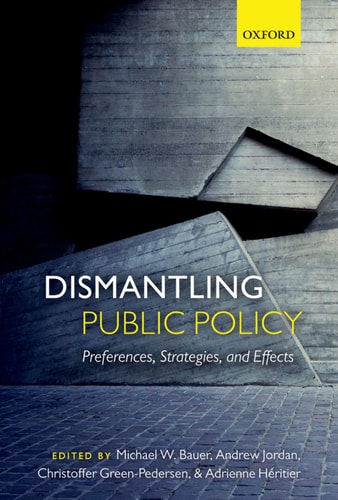
Dismantling Public Policy: Preferences, Strategies, and Effects
0
0
As an Amazon Associate and affiliate partner, Menrva Books earns from qualifying purchases. Learn more
Author Description
Policy dismantling is a distinctive form of policy change, which involves the cutting, reduction, diminution or complete removal of existing policies. The perceived need to dismantle existing policies normally acquires particular poignancy during periods of acute economic austerity. Dismantling is thought to be especially productive of political conflict, pitting those who benefit from the status quo against those who, for whatever reason, seek change. However, scholars of public policy have been rather slow to offer a comprehensive account of the precise conditions under which particular aspects of policy are dismantled, grounded in systematic empirical analysis. Although our overall understanding of what causes policy to change has accelerated a lot in recent decades, there remains a bias towards the study of either policy expansion or policy stability. Dismantling does not even merit a mention in most public policy textbooks. Yet without an account of both expansion and dismantling, our understanding of policy change in general, and the politics surrounding the cutting of existing policies, will remain frustratingly incomplete.This book seeks to develop a more comparative approach to understanding policy dismantling, by looking in greater detail at the dynamics of cutting in two different policy fields: one (social policy) which has been subjected to study before and the other (environmental policy) which has not. On the basis of a systematic analysis of the existing literatures in these two fields, it develops a new analytical framework for measuring and explaining policy dismantling. Through an analysis of six, fresh empirical cases of dismantling written by leading experts, it reveals a more nuanced picture of change, focusing on what actually motivates actors to dismantle, the strategies they use to secure their objectives and the politically significant effects they ultimately generate.
Menrva's Summary
THE THESIS
This book investigates the mechanisms, motivations, and political consequences of policy dismantling, a neglected area of public policy research. The authors, a team of expert political scientists, address the academic bias toward studying policy expansion and stability by providing a systematic framework for analyzing policy reduction. They utilize a comparative approach, contrasting social and environmental policy fields to explain why and how governments cut existing programs during periods of economic austerity.
THE SCOPE MAP
What You Will Find
- A new analytical framework for measuring and explaining policy dismantling.
- Comparative analysis of social policy and environmental policy sectors.
- Six fresh empirical case studies detailing specific instances of policy cuts.
- Examination of actor motivations, strategic implementation, and political outcomes.
THE AUTHORITY PERSPECTIVE
Experts identify this work as a necessary intervention in public policy literature, filling a significant gap regarding the politics of retrenchment. Readers frequently note the academic rigor of the comparative framework and its utility for students and practitioners of political science.
Page Count:
242
Publication Date:
2014-09-15
Publisher:
Oxford University Press
ISBN-10:
0198714785
ISBN-13:
9780198714781
Economics
Social policy
Public Policy
Government
Community Tags
Similar Books




Reader Comments
Share Your Thoughts
No comments yet. Be the first to share your thoughts!