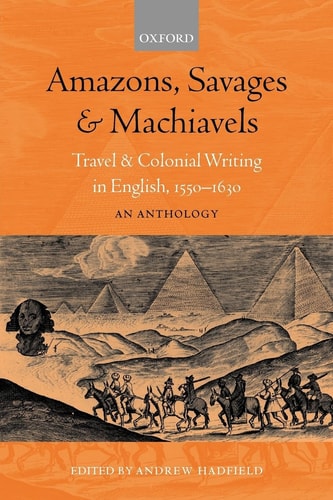
Amazons, Savages, and Machiavels: Travel and Colonial Writing in English, 1550-1630: An Anthology
0
0
As an Amazon Associate and affiliate partner, Menrva Books earns from qualifying purchases. Learn more
Author Description
Amazons, Savages, and Machiavels is an accessible and unique anthology of travel and colonial writing in the English Renaissance, selected to represent the world-picture of sixteenth- and seventeenth-century readers in England. It includes not just the narratives of discovery of the New World but also accounts of cultures already well known through trade links, such as Turkey and the Moluccan islands, and of places that featured just as significantly in the early modern English imagination: from Ireland to Russia and the Far East, from Calais to India and Africa, from France and Italy to the West Indies. Ranging from Raleigh's account of the Amazons and Captain John Smith's story of Pocahontas to Coryat's cheerful encounter with a Venetian courtesan and Florio's translation of Montaigne's famous "Of the Cannibals," the volume also includes helpful headnotes, a substantial introduction, chronology, full bibliography, and seventeen original illustrations.
Menrva's Summary
THE THESIS
This anthology investigates how English travel and colonial narratives between 1550 and 1630 constructed the early modern world-picture and shaped the national imagination. Andrew Hadfield, a scholar of English Renaissance literature, curates a diverse collection of primary sources to demonstrate how English writers perceived both newly discovered territories and established trading partners. By contextualizing these texts, the volume argues that colonial identity was formed through a complex interaction with foreign cultures ranging from Ireland and Russia to the West Indies and the Far East.
THE SCOPE MAP
What You Will Find
- Primary source accounts of exploration, trade, and cultural encounters from 1550 to 1630.
- A broad geographical range including Turkey, the Moluccan islands, France, Italy, India, and Africa.
- Scholarly apparatus including headnotes, a substantial introduction, a chronology, and a full bibliography.
- Seventeen original illustrations providing visual context for early modern perspectives.
THE AUTHORITY PERSPECTIVE
Scholars and students of the English Renaissance frequently cite this anthology as a foundational resource for understanding the intersection of colonial expansion and literary production. The text is noted for its accessibility and the breadth of its selections, making it a standard reference for those studying the development of early modern English identity.
Page Count:
336
Publication Date:
2001-11-15
Publisher:
Oxford University Press
ISBN-10:
0198711867
ISBN-13:
9780198711865
History
Travel
Great Britain
Foreign countries
Colonialism
Anthology
Literary Criticism
Community Tags
Similar Books