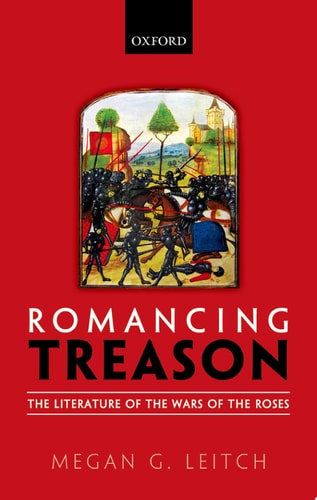
Romancing Treason: The Literature of the Wars of Roses
0
0
As an Amazon Associate and affiliate partner, Menrva Books earns from qualifying purchases. Learn more
Author Description
Romancing Treason addresses the scope and significance of the secular literary culture of the Wars of the Roses, and especially of the Middle English romances that were distinctively written in prose during this period. Megan Leitch argues that the pervasive textual presence of treason during the decades c.1437-c.1497 suggests a way of conceptualising the understudied space between the Lancastrian literary culture of the early fifteenth century and the Tudor literary cultures of the early and mid-sixteenth century. Drawing upon theories of political discourse and interpellation, and of the power of language to shape social identities, this book explores the ways in which, in this textual culture, treason is both a source of anxieties about community and identity, and a way of responding to those concerns. Despite the context of decades of civil war, treason is an understudied theme even with regards to Thomas Malory's celebrated prose romance, the Morte Darthur. Leitch accordingly provides a double contribution to Malory criticism by addressing the Morte Darthur's engagement with treason, and by reading the Morte in the hitherto neglected context of the prose romances and other secular literature written by Malory's English contemporaries. This book also offers new insights into the nature and possibilities of the medieval romance genre and sheds light on understudied texts such as the prose Siege of Thebes and Siege of Troy, and the romances William Caxton translated from French. More broadly, this book contributes to reconsiderations of the relationship between medieval and early modern culture by focusing on a comparatively neglected sixty-year interval -- the interval that is customarily the dividing line, the 'no man's land' between well--but separately-studied periods in English literary studies.
Menrva's Summary
THE THESIS
This book investigates how the pervasive theme of treason in Middle English prose romances written between 1437 and 1497 functioned as a mechanism for conceptualizing political identity and community during the Wars of the Roses. Megan Leitch, a scholar of medieval literature, utilizes political discourse theory and the concept of interpellation to analyze how language shaped social identities during this volatile sixty-year interval. By positioning these texts within the neglected space between Lancastrian and Tudor literary cultures, the author argues that treason served as both a source of anxiety and a tool for navigating the civil unrest of the era.
THE SCOPE MAP
What You Will Find
- Analysis of Middle English prose romances including the Morte Darthur, the Siege of Thebes, and the Siege of Troy.
- Application of political discourse theory and interpellation to medieval literary texts.
- Examination of the sixty-year period between 1437 and 1497, often treated as a transitional 'no man's land' in literary history.
- Comparative study of Thomas Malory's work alongside contemporary prose romances and translations by William Caxton.
THE AUTHORITY PERSPECTIVE
Scholars recognize this work as a significant contribution to the study of fifteenth-century English literature, particularly for its focus on the Morte Darthur within its immediate historical context. Readers frequently note the academic density of the prose, which serves as a rigorous examination of the intersection between political instability and literary production.
Page Count:
240
Publication Date:
2015-03-29
Publisher:
Oxford University Press
ISBN-10:
0198724594
ISBN-13:
9780198724599
History
Literary Criticism
English literature
Community Tags
Similar Books