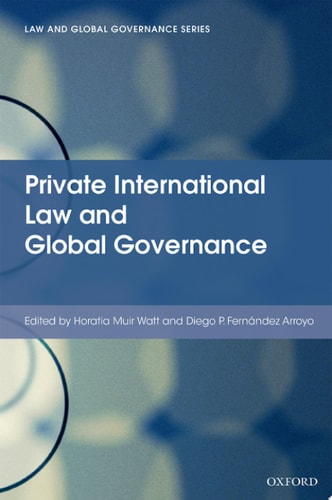
Private International Law and Global Governance
0
0
As an Amazon Associate and affiliate partner, Menrva Books earns from qualifying purchases. Learn more
Author Description
Contemporary debates about the changing nature of law engage theories of legal pluralism, political economy, social systems, international relations (or regime theory), global constitutionalism, and public international law. Such debates reveal a variety of emerging responses to distributional issues which arise beyond the Western welfare state and new conceptions of private transnational authority. However, private international law tends to stand aloof, claiming process-based neutrality or the apolitical nature of private law technique and refusing to recognize frontiers beyond than those of the nation-state. As a result, the discipline is paradoxically ill-equipped to deal with the most significant cross-border legal difficulties - from immigration to private financial regulation - which might have been expected to fall within its remit. Contributing little to the governance of transnational non-state power, it is largely complicit in its unhampered expansion. This is all the more a paradox given that the new thinking from other fields which seek to fill the void - theories of legal pluralism, peer networks, transnational substantive rules, privatized dispute resolution, and regime collision - have long been part of the daily fare of the conflict of laws. The crucial issue now is whether private international law can, or indeed should, survive as a discipline.This volume lays the foundations for a critical approach to private international law in the global era. While the governance of global issues such as health, climate, and finance clearly implicates the law, and particularly international law, its private law dimension is generally invisible. This book develops the idea that the liberal divide between public and private international law has enabled the unregulated expansion of transnational private power in these various fields. It explores the potential of private international law to reassert a significant governance function in respect of new forms of au
Menrva's Summary
THE THESIS
This volume investigates whether private international law can maintain its relevance as a discipline while addressing the complex challenges of global governance and the expansion of transnational private power. The authors, Diego P. Fernández Arroyo and Horatia Muir Watt, challenge the traditional liberal divide between public and private international law. By analyzing the historical neutrality of private law techniques, they argue that this separation has inadvertently facilitated the unregulated growth of non-state power in areas such as finance, climate, and health. The work proposes a critical framework to re-evaluate the discipline's role in the modern globalized era.
THE SCOPE MAP
What You Will Find
- Analysis of the intersection between private international law and global governance regimes.
- Critical examination of the liberal divide between public and private international law.
- Discussion of legal pluralism, transnational substantive rules, and privatized dispute resolution.
- Exploration of distributional issues arising beyond the traditional Western welfare state.
THE AUTHORITY PERSPECTIVE
Experts recognize this volume as a significant contribution to the critical re-evaluation of conflict of laws in a globalized context. Readers frequently note the academic density of the prose and its utility for scholars examining the intersection of private law and international political economy.
Page Count:
400
Publication Date:
2015-02-18
Publisher:
Oxford University Press
ISBN-10:
0198727623
ISBN-13:
9780198727620
Legal Theory
International Law
Law
Community Tags
Similar Books