International Toxic Risk Management: Ideals, Interests and Implementation
0
0
As an Amazon Associate and affiliate partner, Menrva Books earns from qualifying purchases. Learn more
Author Description
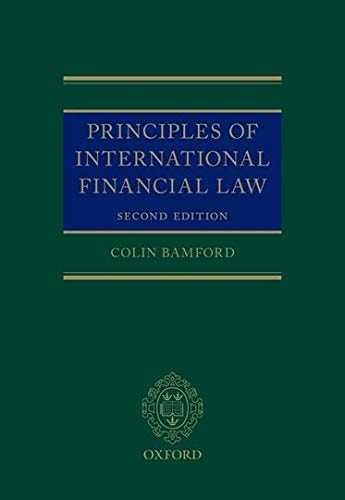
Review"Because of its broad approach, this is not only a rich, but also an important book. It approaches financial law from a property and contract law (together: commercial law) perspective, a perspective that is not commonly associated with financial law. To be applauded, too, are the contemporary additions this second edition has brought. In all, the book makes for essential reading for both practicing lawyers and academics working in financial markets." -Matthias Haentjens, Leiden University, Journal of International Banking Law and RegulationProduct DescriptionThis book explains the legal principles and rules, concepts and developments that underpin the practice of financial law in common law countries, and by extension across the world.One of the aims of the book is to explain clearly the basis of the concepts applied by the common law to financial transactions. As part of this aim the second edition analyses in more detail the interface between common-law and civil law approaches in areas such as the distinction between propertyand personal rights. Additionally, the chapter on Contractual Interpretation has been broadened in scope so that it deals with common law judicial methodology in a wider sense, and treats the question of interpretation as part of that wider approach.Since the last edition was written there have been a number of major changes, not least relating to the ongoing challenges following the financial crisis. In Chapter 2 the material on the Euro has been expanded to explain the Eurozone crisis, and its consequences. Additionally, there is a newsection on virtual currencies.This is an essential work for both experienced lawyers and those who are relatively new to international financial law. It provides the more experienced lawyer with an aide memoire on the existing law and a reference source for new ideas when tackling innovative structures or products. For those newto practice or postgraduate students this book delivers a firm foundation upon which to build knowledge of the law and practice of financial law.About the AuthorColin Bamford, Barrister, 3-4 South SquareColin Bamford has worked as a barrister at 3-4 South Square where he advised on a range of issues relating to the banking and securities industries. He is an Honorary Fellow of the Society for Advanced Legal Studies and a member of its Advisory Committee, a former Visiting Senior Fellow at LondonSchool of Economics, and a member of the committee of the Centre for Corporate Law at the Institute of Advanced Legal Studies.
Menrva's Summary
THE THESIS
This book investigates the complex interplay between political ideals, national interests, and the practical implementation of international regulatory frameworks for toxic risk management. Aynsley Kellow, a scholar in public policy and environmental politics, examines how global governance structures struggle to reconcile scientific evidence with the competing economic and political agendas of sovereign states. By analyzing the mechanisms of international agreements, the author argues that the effectiveness of toxic risk regulation is frequently compromised by the divergence between stated policy goals and the realities of national enforcement. The text provides a rigorous framework for understanding why international environmental regimes often fail to achieve their intended outcomes.
THE SCOPE MAP
What You Will Find
- Analysis of the institutional design of international environmental agreements.
- Examination of the tension between scientific consensus and political negotiation.
- Case studies detailing the implementation of chemical safety regulations across different jurisdictions.
- Evaluation of the influence of multinational corporations and interest groups on regulatory outcomes.
THE AUTHORITY PERSPECTIVE
Experts in the field of international relations and environmental policy recognize this work as a comprehensive study of the structural challenges inherent in global risk governance. Readers frequently note the analytical depth of the author's approach to the intersection of policy theory and practical implementation.
Page Count:
234
Publication Date:
1999-10-13
Publisher:
Cambridge University Press
ISBN-10:
0198722109
ISBN-13:
9780198722106
Law
International relations
Community Tags
Similar Books





Reader Comments
Share Your Thoughts
No comments yet. Be the first to share your thoughts!