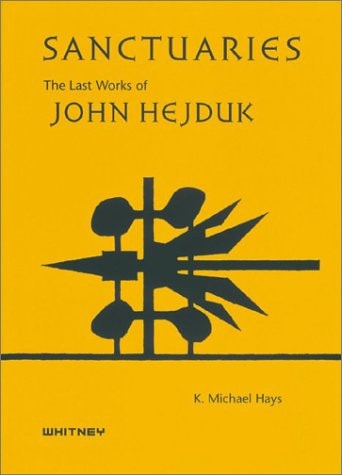
Sanctuaries: The Last Works of John Hejduk
0
0
As an Amazon Associate and affiliate partner, Menrva Books earns from qualifying purchases. Learn more
Author Description
John Hejduk (1929-2000) was one of the most original figures in American architecture and design. Best known for his visionary works and his influence upon graduates of The Cooper Union, New York, where he was dean for twenty-five years, Hejduk largely abstained from conventional practice, focusing instead on theoretical projects, usually in the form of drawings that were combined into poetic, highly personal narratives. Sanctuaries: The Last Works of John Hejduk highlights the architect's later work, in which he made successive attempts to shift his architecture away from the mathematical concerns of his earlier work - which had owed much to Mies van der Rohe and Mondrian - toward an allegorical, carnivalesque mode that he called architectural "masques." In these works, Hejduk presented his architecture in a more lyrical, painterly, and narrative way, and in the last of the works - including Enclosures, a suite of thirty-two drawings reproduced here in its entirety - returned architecture to an overtly spiritual function. The works display a stylistic range from basic geometric forms and elemental biomorphism (buildings that seem to have hair, beaks, eyes, and legs) to typological variations on theaters, periscopes, traps, chapels, and labyrinths. Employing allegorical images of angels, animals, martyrs, and machines, these works explore themes of falls from grace, itinerancy, passage and transformation, and above all, architecture as sanctuary - for art, for culture, for enduring rituals, for the human spirit itself.
Menrva's Summary
THE THESIS
This book explores the late works of visionary architect John Hejduk, focusing on his shift towards allegorical and spiritual architectural concepts. K. Michael Hays, in association with the Harvard Design School, presents selections from the John Hejduk Archive at the Canadian Centre for Architecture and The Menil Collection. The volume highlights Hejduk's transition from mathematical rigor to a more lyrical, painterly, and narrative approach, termed architectural "masques." These later works, including the complete suite of drawings for "Enclosures," investigate themes of passage, transformation, and architecture as a sanctuary for art, culture, and the human spirit.
THE SCOPE MAP
- Selections from the John Hejduk Archive at the Canadian Centre for Architecture and The Menil Collection.
- Focus on Hejduk's later architectural works and theoretical projects.
- Analysis of his shift from mathematical concerns to allegorical and carnivalesque "masques."
- Reproduction of the complete suite of thirty-two drawings for "Enclosures."
- Exploration of stylistic range from geometric forms to biomorphism.
- Examination of themes including falls from grace, itinerancy, passage, transformation, and sanctuary.
- Inclusion of allegorical images of angels, animals, martyrs, and machines.
THE AUTHORITY PERSPECTIVE
The book is presented in conjunction with an exhibition at the Whitney Museum of American Art, indicating its significance within architectural and art historical discourse. The existing description highlights Hejduk's unique position as an influential figure known for his visionary theoretical projects rather than conventional practice. It suggests the work will appeal to those interested in the evolution of architectural thought, particularly the move towards more lyrical, spiritual, and narrative-driven design. The focus on his "masques" and the exploration of architecture as sanctuary points to a deep dive into the symbolic and functional aspects of his late career.
Page Count:
104
Publication Date:
2002-01-01
Publisher:
Harry N. Abrams
ISBN-10:
0874271290
ISBN-13:
9780874271294
Architecture
Art
Non-Fiction
Art History
Community Tags
Similar Books