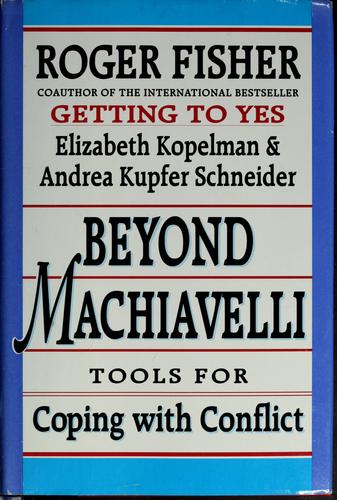
Beyond Machiavelli
0
0
As an Amazon Associate and affiliate partner, Menrva Books earns from qualifying purchases. Learn more
Author Description
Conflict is a growth industry, as a glance at the daily paper or the nightly news tells us. Trade wars, global warming, ethnic strife, refugee crises - as the world draws closer together on a thousand fronts, trouble erupts, clashes occur, and new problems arise. What's wrong, and what can be done about it? This cogent book offers a clear approach for dealing with conflicting interests of any kind. Roger Fisher, the world-renowned master of negotiation, with two of his leading colleagues - Elizabeth Kopelman and Andrea Kupfer Schneider - provides a step-by-step process for dealing with the persistent and complex disputes that mark our changing, often dangerous world. Instead of simply asking why things work - or don't - the authors ask: how can we affect the way things work? They break conflicts into manageable components and advance a process for problem-solving. Arguing that we need to move beyond one-shot "solutions" toward a constructive way of dealing with differences, they lay out tools for conflict analysis and practical applications for those tools in the international arena. The authors also show that tactics which successfully influence an adversary are equally applicable to the task of persuading an employer, a community official, or a business associate. Originally drafted as a handbook for the diplomats and senior officials advised by Fisher and his colleagues, this succinct, lucid, and effective book is the primer about the new paradigm in conflict management.
Menrva's Summary
THE THESIS
This book offers a structured approach to managing and resolving conflicts in an increasingly interconnected world. The authors, drawing on their expertise in negotiation, present a step-by-step process for analyzing and addressing disputes across various domains, from international relations to business and personal interactions. They advocate for moving beyond temporary fixes to establish constructive methods for managing differences, providing practical tools and applications for conflict analysis.
THE SCOPE MAP
- A framework for analyzing the components of any conflict.
- Practical tools for conflict analysis applicable in international, business, and personal contexts.
- Strategies for moving beyond one-shot solutions to constructive conflict management.
- Applications of negotiation tactics for influencing employers, officials, and associates.
- A primer on the new paradigm in conflict management, originally developed for diplomats.
THE AUTHORITY PERSPECTIVE
The book is presented as a practical guide for managing conflicts, emphasizing a structured, analytical approach. Its origins as a handbook for diplomats suggest a focus on actionable strategies and clear frameworks for problem-solving. The authors' emphasis on moving beyond temporary fixes indicates a focus on long-term conflict resolution and management.
Page Count:
151
Publication Date:
1994-01-01
ISBN-10:
0674069161
ISBN-13:
9780674069169
Politics
Business
Non-Fiction
Conflict Resolution
Negotiation
International relations
Business strategy
Community Tags
Similar Books