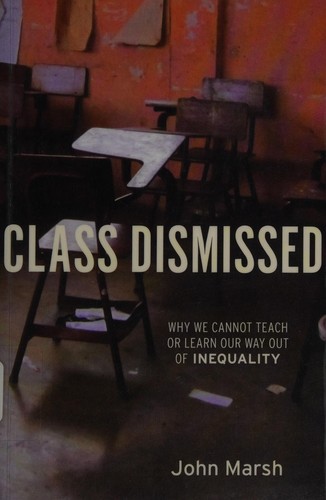
Class Dismissed
0
0
As an Amazon Associate and affiliate partner, Menrva Books earns from qualifying purchases. Learn more
Author Description
"In Class Dismissed, John Marsh debunks a myth cherished by journalists, politicians, and economists: that growing poverty and inequality in the United States can be solved through education. Using sophisticated analysis combined with personal experience in the classroom, Marsh not only shows that education has little impact on poverty and inequality, but that our mistaken beliefs actively shape the way we structure our schools and what we teach in them. Rather than focus attention on the hierarchy of jobs and power--where most jobs require relatively little education, and the poor enjoy very little political power--money is funneled into educational endeavors that ultimately do nothing to challenge established social structures, and in fact reinforce them. And when educational programs prove ineffective at reducing inequality, the ones whom these programs were intended to help end up blaming themselves. Marsh's struggle to grasp the connection between education, poverty, and inequality is both powerful and poignant"-- Provided by publisher.
Menrva's Summary
THE THESIS
The prevailing myth that education is the primary solution to poverty and inequality in the United States is fundamentally flawed. John Marsh, drawing on his classroom experience and rigorous analysis, argues that education has minimal impact on these societal issues and that our persistent belief in its efficacy actively shapes educational structures and curricula in ways that reinforce existing social hierarchies. Instead of addressing the root causes in job markets and power structures, resources are directed towards educational initiatives that fail to challenge the status quo, leading those intended to benefit to internalize blame for their lack of progress.
THE SCOPE MAP
- Debunks the myth that education can solve poverty and inequality.
- Analyzes the impact of educational structures on social hierarchies.
- Examines the role of journalism, politics, and economics in perpetuating this myth.
- Discusses how educational programs can inadvertently reinforce established social structures.
- Explores the psychological impact on individuals when educational programs fail to deliver on promises of upward mobility.
- Presents a critique of current educational funding and curriculum design.
THE AUTHORITY PERSPECTIVE
The book challenges deeply ingrained assumptions about the role of education in addressing societal inequality. Marsh's work is noted for its direct confrontation of established narratives, offering a critical perspective on how educational systems may inadvertently perpetuate the very problems they aim to solve. The analysis is presented as both intellectually rigorous and personally resonant, stemming from the author's direct experience. This perspective suggests the book is likely to provoke discussion among educators, policymakers, and those concerned with social justice.
Page Count:
255
Publication Date:
2011-01-01
ISBN-10:
1583672435
ISBN-13:
9781583672433
Politics
Economics
Non-Fiction
Social Issues
Sociology
Education
Community Tags
Similar Books