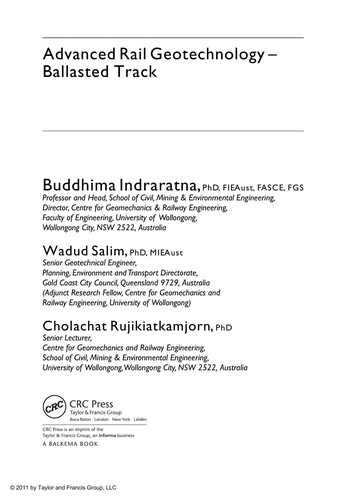
Advanced Rail Geotechnology: Ballasted Track
0
0
As an Amazon Associate and affiliate partner, Menrva Books earns from qualifying purchases. Learn more
Author Description
Ballast plays a vital role in transmitting and distributing the train wheel loads to the underlying sub-ballast and subgrade. Bearing capacity of track, train speed, riding quality and passenger comfort all depend on the stability of ballast through mechanical interlocking of particles. Ballast attrition and breakage occur progressively under heavy cyclic loading, causing track deterioration and rail misalignment affecting safety, and also demanding frequent and costly track maintenance. In the absence of realistic constitutive models, the track substructure is traditionally designed using empirical approaches. In this book, the authors present the detailed information on the strength, deformation, and degradation aspects of fresh and recycled ballast under monotonic, cyclic, and impact loading using innovative geotechnical testing devices. A new stress-strain constitutive model for ballast incorporating particle breakage is presented. The mathematical formulations and numerical models are validated using experimental evidence and field trials. The effectiveness of various commercially available geosynthetics for enhancing track drainage and stability is elucidated. Revised ballast gradations are presented for modern high speed trains capturing particle breakage. This book should prove useful for final year civil engineering students and postgraduates, and for practicing railway engineers with the task of modernizing existing designs for heavier and faster trains
Menrva's Summary
THE THESIS
Ballast stability is critical for safe and efficient rail transport, yet it is prone to degradation under cyclic loading. The book details the strength, deformation, and degradation of fresh and recycled ballast using advanced geotechnical testing devices, presenting a new constitutive model that incorporates particle breakage. It validates these models with experimental and field data, and explores the use of geosynthetics to improve track drainage and stability. The authors also propose revised ballast gradations suitable for modern high-speed trains.
THE SCOPE MAP
- Detailed analysis of ballast strength, deformation, and degradation under monotonic, cyclic, and impact loading.
- Presentation of innovative geotechnical testing devices for ballast characterization.
- Introduction of a novel stress-strain constitutive model for ballast that accounts for particle breakage.
- Validation of mathematical formulations and numerical models using experimental evidence and field trials.
- Elucidation of the effectiveness of various commercially available geosynthetics for enhancing track drainage and stability.
- Revised ballast gradations proposed for modern high-speed trains, considering particle breakage.
THE AUTHORITY PERSPECTIVE
This book is presented as a valuable resource for final year civil engineering students, postgraduates, and practicing railway engineers involved in modernizing rail infrastructure. The publisher's description highlights the detailed information on ballast behavior and the presentation of new models and experimental validations. The content focuses on practical applications for improving track stability and maintenance for heavier and faster trains.
Page Count:
414
Publication Date:
2011-01-01
ISBN-10:
041566957X
ISBN-13:
9780415669573
Non-Fiction
Science & Technology
Geotechnical Engineering
Civil Engineering
Engineering
Transportation Engineering
Community Tags
Similar Books