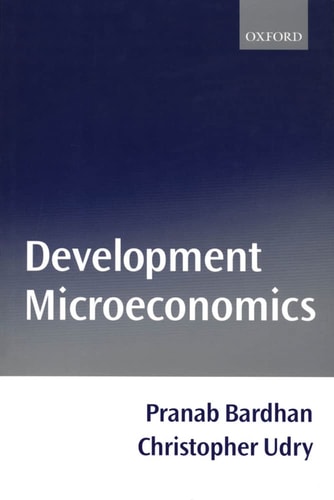
Development Microeconomics
0
0
As an Amazon Associate and affiliate partner, Menrva Books earns from qualifying purchases. Learn more
Author Description
Traditional development economics has recently been revolutionized by the application of new economic tools and concepts. Development Microeconomics is the first in a series of books which will look at the entire spectrum of development economics issues, combining the strengths of conventional developmental thought with the insights of contemporary mainstream economics. The main new conceptual tool used is the application of the theory of imperfect information and the effects this has on the the behaviour of economic agents. This helps to explain why perfect competition models rarely have success when dealing with developing economies. The authors also stress the necessity of balance in dealing with many of the classic problems in development studiesthe importance of both the individual as economic agent and cultural norms as the framework of social behaviour; the dual relationship between equity and efficiency in economic policy-making; the importance of market rivalry and the potential of market breakdown. Designed specifically for graduate students, this book analyses the key microeconomic problems facing the very poorest sectors of developing economies. It utilises simple theoretical models, and is presented in a compact and analytical form. High technical sophistication is avoided, and the only pre-requisite is some familiarity with the tools of general microecomic theory at a first-year graduate or advanced undergraduate level.
Menrva's Summary
THE THESIS
This text investigates how the application of imperfect information theory can explain the unique economic behaviors observed in developing nations. Authors Christopher Udry and Pranab Bardhan, both established scholars in the field, synthesize conventional development thought with modern mainstream economic tools. By moving away from perfect competition models, the authors provide a framework for understanding the constraints and decision-making processes of economic agents in impoverished sectors.
THE SCOPE MAP
What You Will Find
- Theoretical models focusing on imperfect information and market failure.
- Analysis of the relationship between equity and efficiency in policy-making.
- Examination of the interplay between individual agency and cultural norms.
- Methodological approaches for graduate-level study of microeconomic problems in developing economies.
THE AUTHORITY PERSPECTIVE
Experts recognize this work as a foundational text for graduate students seeking to bridge traditional development theory with contemporary analytical tools. Readers frequently note that the prose maintains a high level of technical rigor while remaining accessible to those with a basic background in microeconomic theory.
Page Count:
256
Publication Date:
1999-06-24
Publisher:
Oxford University Press
ISBN-10:
0198773706
ISBN-13:
9780198773702
Economics
Academic
textbook
Microeconomics
Community Tags
Similar Books